
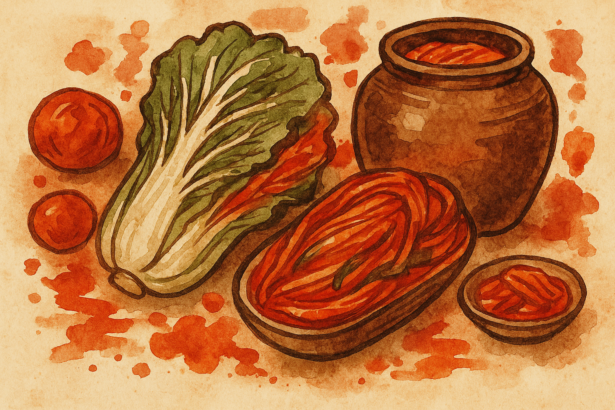
On a winter morning in Seoul, the world seems to slow down. The air is crisp, snow lies like lace on rooftops, and a quiet rhythm hums through the narrow alleys. Women gather in courtyards, sleeves rolled up, hands deep in bowls of red pepper paste. They are making kimchi — that ancient alchemy of salt, spice, and time that has nourished Korea for over two thousand years.
Around them, history lingers like steam: centuries of invasion, resilience, reinvention — all preserved in a single jar. Kimchi is more than a dish. It’s a metaphor — for endurance, transformation, and identity. To taste it is to taste the story of a people who turned scarcity into art, who found beauty in decay, and who discovered that sometimes, survival itself ferments into flavour.
Long before chili ever painted it red, kimchi was pale and simple — salted radish, cabbage, or cucumber brined to survive brutal Korean winters. Ancient texts from the Three Kingdoms Period (around 37 BCE) mention fermented vegetables as staples of the Korean table. With limited harvests and freezing months, fermentation was a necessity — a way to keep the earth alive in jars when fields slept under frost.
But then came the spark — literally. In the 16th century, chili peppers arrived in East Asia through Portuguese traders from the Americas. Korea, always a land of elemental contrasts, embraced this fiery outsider. Within a century, the humble white pickle was reborn as the red, garlicky, full-bodied kimchi we know today. It became both flavour and flag — hot, bold, unmistakably Korean.
If there is one word that holds kimchi’s soul, it is kimjang — the collective, ritualistic making of kimchi that once marked the beginning of every winter. Villages turned into symphonies of motion: women chopping, washing, seasoning, whispering family stories into the mix. It was not just about food preservation; it was memory preservation.
Each household’s kimchi was slightly different — spicier in the south, saltier in the north, sweeter near the coast — but all shared a common heartbeat: the care of women who fed generations.
Today, UNESCO lists kimjang as an Intangible Cultural Heritage of Humanity, calling it an “expression of sharing and harmony.” It’s also an echo of something universal — the way women across cultures have always transformed necessity into nourishment, ritual into art. Through every chapter of Korean history — invasions by Mongols, occupation by Japan, civil war — kimchi remained the one constant. When foreign rulers tried to suppress local customs, kimchi endured quietly in kitchens, like a hidden prayer.
Soldiers carried it to battlefields; families smuggled it across borders; immigrants took its recipe as their last piece of home. Kimchi became a culinary flag — a statement of identity no coloniser could erase. When Korea split into North and South, even the ingredients diverged — one land using more garlic and chili, the other more salt and fish — but the spirit stayed the same. Every jar was a manifesto: we are still here.
Modern wellness culture calls kimchi a superfood. Nutritionists praise its probiotics, its vitamins, its role in gut health. But long before science gave it vocabulary, Koreans understood its philosophy. Fermentation is slow, invisible transformation — the kind of quiet change that requires surrender and faith. To make kimchi, you must let go of control. You salt, you season, you seal — and then you wait.
Nature does the rest. Bacteria you cannot see create flavors you cannot predict. Perhaps that’s why kimchi feels almost spiritual: it’s food that teaches you to trust time. In a world obsessed with speed, kimchi is a reminder that good things still take days, not minutes.
Today, kimchi has crossed continents. It sits proudly beside tacos in Los Angeles, burgers in London, and sushi in Tokyo. Michelin-starred chefs reinterpret it in tasting menus; wellness influencers blend it into smoothie bowls. Yet, beneath all this glamour, it remains what it always was — fermented memory. It is astonishing how something born from hardship can become an emblem of sophistication. Perhaps that’s kimchi’s secret: it outlasts trends because it carries truth. It tastes of earth and endurance, of ancient kitchens and modern palates, of cultures that bend but do not break.
Every bite of kimchi is a paradox — sharp yet soft, fiery yet comforting, ancient yet alive. It reminds us that preservation is not stagnation, that the past can still feed the future. Empires have risen and fallen, borders redrawn, palates globalised — yet the humble jar remains. The same salt, the same patience, the same red glow of courage.
In the end, kimchi is not just Korea’s story. It’s the story of all of us — the human instinct to survive, to adapt, and to create beauty from what could have been ruin. Because what ferments, endures. And what endures, becomes eternal.
Andrea Sipos is a Yoga Teacher and Conscious Lifestyle Coach. She lives in Bucharest, Romania. She is Consulting Editor, Lifestyle at Mocha Ink Mag.
