And Why AI Can’t Reach That Place
For me, art does not begin with skill.
It begins somewhere softer. Deeper. Quieter.
It begins with lived experience.
Skill arrives later—through repetition, discipline, muscle memory. Emotion, however, is less polite. It leaks into the work whether you invite it or not. It shows up in pauses, in choices you can’t always explain, in the instinct to stop just before something becomes too perfect.
I notice this most clearly at home, in the ordinary theatre of everyday life.
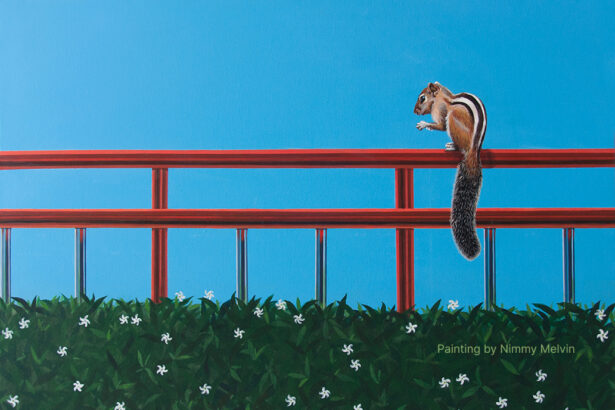
My wife, Nimmy, is a fine artist—trained, rigorous, deeply loyal to process. Her paintings are built slowly, layer by layer, through years of looking, waiting, correcting. There is nothing rushed about her work. It carries the weight of time. My daughter, Teresa, is still discovering her voice. Her lines are raw, sometimes uneven, often unfinished—and yet startlingly honest. She hasn’t learned what to conceal yet. That innocence, that willingness to show up without armour, is its own kind of mastery.
I sit somewhere else altogether—working with digital art, design systems, brands, and products. My world is grids and interfaces, language and intention, ideas translated into form. Different tools. Same question: why does this need to exist?
Living with two artists has clarified something no manifesto ever could.
AI can imitate style.
It cannot accumulate doubt.
It cannot absorb years of dinner-table conversations, creative silences, unfinished canvases leaning against walls. It cannot know what it feels like to watch someone you love struggle with their work—and still return to it the next morning.
That origin point—the place art truly begins—remains human.
I’ve lived through enough technological shifts to recognise the pattern. Photoshop. Illustrator. Figma. Generative design systems. Each arrival carried its own anxiety, its own promises. AI feels different—not because it is frightening, but because it changes where the work begins.
Earlier, tools helped us execute.
Now, tools help us decide faster.
Authorship is quietly shifting. It’s moving from “I made this with my hands” to “I chose this direction with intention.” The labour moves upstream—from output to judgment, from craft alone to discernment. I use AI to visualise ideas quickly, test possibilities, move past the obvious. Not to finish the work, but to arrive at its core sooner. To create space for thinking, editing, refining.
If intention is the soul of art, then the answer is simple.
The human holds intention.
An algorithm does not wake up with uncertainty. A dataset does not care if the work matters. Intention comes from deciding why something should exist at all. That responsibility has not shifted. It still rests squarely with us.
And then there is vulnerability—the most fragile, irreplaceable ingredient of all.
I don’t believe meaningful art exists without it.
When Nimmy paints, she brings her failures, her patience, her lived silences into the canvas. When Teresa draws, she experiments without fear, unaware of judgment, and that openness is a vulnerability too. AI risks nothing. It cannot be misunderstood. It cannot feel the sting of rejection or the quiet ache of being unseen.
AI can generate images.
Vulnerability still belongs to us.
People worry about mastery in a world where beauty can be produced in seconds. But mastery hasn’t disappeared—it has simply migrated. Technical skill is becoming accessible. Judgment, taste, restraint—these are becoming rare. I’ve seen perfectly generated visuals that say nothing. And I’ve seen clumsy sketches that carry emotional gravity.
Mastery is moving upstream—from execution to discernment.
And yes, people can feel the difference. Even when they can’t articulate it.
They may not say, “This was made by a human,” but they will say, “This feels honest,” or “This feels hollow.” The body recognises intention before the mind names technique.
AI will do two things at once. It will amplify shallow work. And it will deepen serious work. It removes friction. What you do with that freedom reveals who you are. If your work skimmed the surface before, it will now move faster and louder. If you already cared about meaning, AI gives you more room to pause, to refine, to choose with care.
The tool does not decide.
The artist does.
In a future flooded with images, originality will be easy. Process will be automated. What will grow scarce—and precious—is presence. Showing up, again and again, with a way of seeing the world. Not just what you make, but how you look.
My wife’s students don’t just learn technique from her. They learn her gaze. Her patience. Her way of noticing. That cannot be scaled.
Labeling AI-generated work doesn’t diminish art. Confusing everything into sameness does. Context has always mattered. Transparency builds trust. Art has always lived within mediums—oil, photography, digital. AI is simply another one.
But there is one thing human artists must protect fiercely.
Not skill.
Not speed.
Judgment.
The ability to say, this matters—and this doesn’t—and to stand by that decision even when it is slow, uncomfortable, or unfashionable.
Machines can assist.
They cannot decide what is worth caring about.
If I had to say it simply—from my life, not a theory book:
AI will make creating easier.
It will never make choosing meaningful.
That responsibility remains human.
And it always will.
About the author
Melvin Thambi is a Creative Director & Creative Entrepreneur. Husband to a fine artist; father to a young digital artist, he works at the intersection of art, technology, and business with a deep belief that intention, judgment, and presence will always outlast tools.
Art: Nimmy Melvin
