
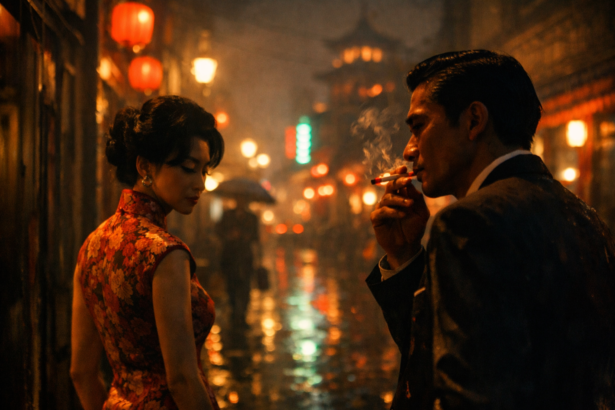
February is advertised as the month of blooming hearts, but anyone who has lived long enough knows it is really the season of remembering. The light is still winter-thin, evenings carry a faint metallic chill, and the mind develops an inconvenient talent for revisiting rooms it once promised to forget. Love, in February, behaves less like a celebration and more like an old correspondence—opened carefully, folded again, never quite discarded. This is why, every year, almost ritualistically, we drift back to In the Mood for Love. Not because it flatters romance, but because it understands the private ache beneath romance’s bright costume.
Wong Kar-wai’s film is not a love story in the conventional sense; it is an anatomy of restraint, a study of two people who discover that longing can be both a wound and a form of character. In its corridors and stairwells, desire learns good manners. The unsaid becomes more eloquent than any confession. February, with its loud instructions to adore, makes this quiet wisdom newly visible. The month urges display; Wong counsels interiority. The culture demands declarations; he films hesitation. Watching the movie now feels like stepping out of a crowded party into a rain-washed street where one can finally hear one’s own thoughts.
Love, he reminds us, is not always a harvest—sometimes it is simply weather we must learn to live inside. And this year the season brings an unexpected continuation. Wong Kar-wai returns not with another film but with Blossoms Shanghai, his first television series, extending his lifelong meditation on memory and desire into the long form of episodes. It is as though the whisper placed inside the walls of Angkor Wat has found a new city in which to echo.
Wong Kar-wai taught us that love is not always a story; sometimes it is a climate. In his Hong Kong corridors, feeling gathers like humidity—unhurried, unavoidable. Maggie Cheung’s qipaos descend staircases as if carrying confidential news; Tony Leung lights cigarettes the way other men sign letters. Nothing overt occurs, and yet the screen trembles with the weight of what is withheld. The film remains the most elegant argument cinema has made for restraint, for the possibility that dignity can be erotic, that the refusal to cross a line may constitute its own form of devotion.
To watch it in February is to recognise how noisy our contemporary idea of romance has become. We live among confessions typed at traffic lights, among relationships announced before they are understood. Wong’s universe moves differently. His lovers rehearse their emotions like conscientious actors, wary of becoming the very betrayal that wounded them. Time in his films behaves like a patient editor, removing the obvious and leaving only what aches.
It is therefore an exquisite coincidence that this same month now brings Wong Kar-wai back to us in an unfamiliar vessel—his first television series, Blossoms Shanghai. The poet of fragments enters the long breath of episodes; the cartographer of fleeting moments accepts the discipline of duration. One could call it a departure, yet it feels more like the continuation of a private conversation begun decades ago.
Wong has always filmed cities as though they were biographies. Hong Kong, Buenos Aires, Phnom Penh—each location in his work remembers more than his characters do. He grew up between languages and addresses, and that early dislocation became the engine of his art. Home in his films is not a place but a question mark, a room temporarily borrowed from the future. Shanghai, the city of his birth and first loss, has hovered at the edge of his cinema like an unmailed postcard. With Blossoms Shanghai he finally walks into that postcard and allows it to speak at length.
The series follows Ah Bao, a man ascending with the fever of 1990s Shanghai, discovering that success too has a temperature. Around him the city learns new appetites—money, glamour, reinvention—while the old neighbourhoods practise the difficult craft of remembering. It is terrain perfectly suited to Wong’s obsessions: the commerce of feeling, the price of ambition, the delicate negotiation between past and present. Where his earlier films observed two hearts in a corridor, here he observes a metropolis learning to breathe after decades of holding its breath.
Television may appear an unlikely home for a director famous for improvisation and delay, yet his cinema was always episodic in spirit. He composes not plots but constellations—moments connected by intuition rather than logic. The longer form offers him what his art secretly desired: permission to linger, to let a melody return in different keys, to watch a character age the way a streetlight does at dusk. Early images from Blossoms Shanghai suggest that the essential elements remain intact: colours steeped in memory, faces half-seen in mirrors, the eloquence of doorframes. But there is also a new generosity, an openness to history itself rather than only its aftertaste.
One thinks of how In the Mood for Love ended—with a secret whispered into the walls of Angkor Wat and sealed with mud. It was a ritual acknowledging that some emotions survive only when protected from explanation. Wong’s art has always resembled that hollow in the stone: a place where feeling is stored rather than spent. Perhaps Blossoms Shanghai is another such chamber, larger and more public, yet built from the same reverence for the unsaid.
For readers of a certain temperament, Wong’s films have long functioned like private libraries. We borrow from them the courage to live with ambiguity, the understanding that not every attachment must reach the marketplace of fulfilment. They remind us that character may consist of what we refuse as much as what we choose, that elegance is a moral posture. In an age impatient for outcomes, his cinema insists on the dignity of process.
February, with its bright distractions, makes this lesson newly urgent each year. The month advertises certainty; Wong offers uncertainty shaped into beauty. He shows that two people sharing noodles can contain more drama than any spectacle, that a city at night may know our secrets better than our friends. To revisit his work now, on the eve of Blossoms Shanghai, is to recognise how steadily he has chronicled the education of the heart.
The series will undoubtedly introduce new rhythms, new faces, perhaps even new conclusions. Yet one suspects the essential question will remain unchanged: how does one live honourably inside desire? Wong has asked this across decades and continents, and his answer has always been musical rather than philosophical.
So let February perform its rituals. Let the roses multiply and the playlists swell. Somewhere beyond the shop windows a film continues to breathe, and a new story from Shanghai prepares to unfold. We return to Wong Kar-wai not for comfort but for clarity—the clarity that comes when longing is treated with respect. His cinema reminds us that love, like a well-kept secret, does not need to be loud to be true.
The Mocha Movie Club celebrates the masters & the classics that still breathe.
