
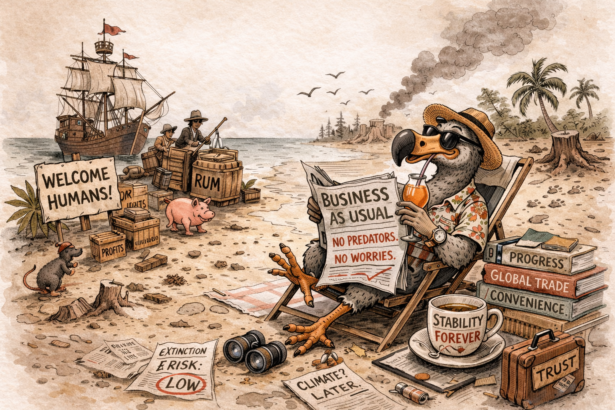
The dodo did not die because it was stupid. This is the first injustice history committed against it. The dodo died because it trusted the system.
For centuries, the bird lived peacefully on the island of Mauritius, an isolated paradise where it evolved without predators. It had no reason to run, no reason to hide, and certainly no reason to develop anxiety. The dodo believed—incorrectly, as it turned out—that the world was essentially benign.
When humans arrived in the late sixteenth century, the dodo greeted them with curiosity. Some accounts suggest it waddled closer, perhaps expecting conversation. Others imply it stood still, waiting for instructions. After all, nothing bad had ever happened before.
This, in hindsight, was its first mistake. The dodo assumed continuity. It believed tomorrow would look like yesterday. It did not factor in disruption.
Humans, for their part, brought ships, rats, pigs, and an unsettling enthusiasm for novelty. They ate the dodos not because they were delicious—most accounts say they were not—but because they were available. The birds had not evolved defenses against appetite combined with boredom.
And so the dodo disappeared, becoming history’s most cited example of extinction by complacency. But to frame this as a failure of evolution alone is to miss the larger lesson. The dodo did not die out. It was phased out.
Had the dodo lived today, it would not have stood still. It would have attended a workshop. Possibly a panel discussion. There would have been a grant proposal explaining why its flightlessness was, in fact, a feature, not a bug. Still, the outcome might have been the same.
The modern dodo is easy to spot. It believes stability is permanent. It mistakes familiarity for safety. It trusts that if it follows the rules, adapts incrementally, and avoids making noise, the system will protect it. The modern dodo believes institutions last forever.
It believes brands are loyal, algorithms neutral, employers benevolent, and platforms fair. It believes that being good, consistent, and polite is enough. It does not expect the ground to shift under its feet without prior notice. The modern dodo is shocked when the email arrives. Extinction today rarely looks dramatic. It is polite. It comes with calendar invites and “quick syncs.” It is delivered in neutral fonts. It assures you this is “not personal.” It suggests reskilling.
The dodo, had it been around now, would have taken notes. One of the enduring myths about the dodo is that it lacked intelligence. In reality, it simply lacked urgency. It lived in an ecosystem that rewarded stillness. When the ecosystem changed, the dodo did not.
This is not laziness. It is pattern loyalty. Humans, on the other hand, are not loyal to patterns. They are loyal to convenience. They bring systems, then abandon them. They build platforms, then burn them. They admire stability right up until it becomes inconvenient. The dodo trusted the island. The island did not anticipate humans. There is something tragically familiar about this.
Entire professions have gone extinct this way. Entire ways of thinking. Entire belief systems. They stood confidently in their relevance, citing precedent, ignoring the boats on the horizon. When extinction finally arrived, it did not announce itself. It arrived disguised as progress.The dodo never saw it coming because it was not looking outward. It was looking inward, perfecting its routine.
In defense of the dodo, adaptation is overrated. Not everything should have to outrun the future to deserve survival. Some things—slowness, depth, patience—are valuable precisely because they resist acceleration.
But history is unkind to things that cannot defend themselves against appetite. The lesson of the dodo is not that it should have flown. It is that it should have noticed when the world began rewarding flight.
Today, we celebrate disruption as a virtue. We admire those who move fast, break things, and leave islands unrecognisable. We rarely mourn what disappears quietly, without drama or hashtags.
The dodo became a cartoon because it made us uncomfortable. It reminded us that innocence does not survive contact with ambition. And yet, we continue to produce dodos. We design systems that reward trust, then punish it. We encourage stability, then monetize chaos. We tell people to build roots, then flood the terrain. When the next species disappears—professional, cultural, emotional—we will act surprised. We will commission think pieces. We will say no one could have predicted this.
The dodo would have disagreed. If it could speak, it might have said: I assumed the world would stay reasonable. That assumption, more than anything else, sealed its fate. The dodo did not die because it failed to evolve. It died because it believed the future would be polite.
A Mocha Ink Satire
