
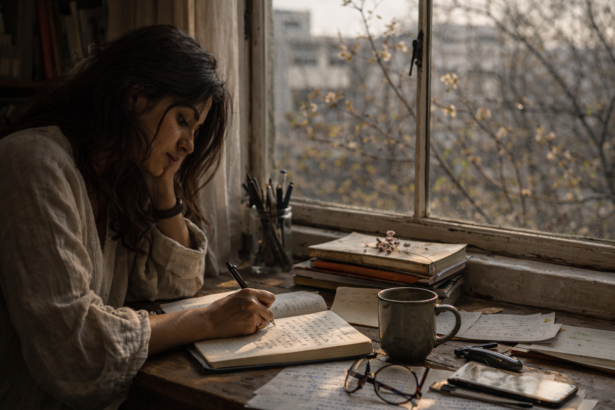
Writing has never been an indulgence for women.
It has been a hiding place.
When the world was too loud, too certain, too uninterested in listening, the page became a room without witnesses. Between pen and paper, a woman could say what she might not survive saying aloud. She could be unruly without punishment, furious without diagnosis, tender without being corrected. The page did not interrupt her. It did not negotiate. It absorbed.
History is crowded with women who found safety there.
When Anne Frank began writing in her diary, she was not trying to create literature. She was trying to stay sane. Confined to an attic, watched by terror, surrounded by adults whose fear had nowhere to go, she wrote to a page she named Kitty. The diary became a friend, a listener, a place where she could still be a thinking, feeling girl and not just a body in hiding. Long after the world failed to keep her safe, her words survived—proof that writing can outlive even the most violent silencing.
Emily Dickinson chose near-complete physical withdrawal, but her interior life was ferociously alive. She wrote hundreds of poems she never sought to publish, stitching them into small fascicles and tucking them away in drawers. The world she lived in offered little tolerance for a woman who thought too much, felt too intensely, or refused conventional visibility. On the page, she did not need permission. Her poems were not performances; they were shelters—compact, exact, fiercely private.
For Virginia Woolf, writing was not merely expression but survival. During periods when speech fractured under the weight of illness and expectation, writing steadied her. Diaries, essays, novels—all became places where thought could move freely when life could not. Woolf understood that women’s minds needed rooms as much as bodies did, and she built those rooms sentence by sentence. On the page, she could hold contradiction without apology. She could think at her own pace. That was safety.
In a very different register, Kamala Das found refuge in radical honesty. In a society that demanded decorum from women and silence about their inner lives, she wrote of desire, loneliness, the female body, and emotional hunger without flinching. Speech would have been punished. Writing allowed her to be truthful without asking for absolution. The page protected her even as it exposed her. It was the only place where she did not have to behave.
Even for Sylvia Plath, whose relationship with language was volatile and exacting, the page was a controlled space where chaos could be shaped. Her journals reveal a woman using writing as a stabiliser—measuring despair, containing it, giving it form. What the world labelled excess, the page treated as material. Writing did not cure her suffering, but it gave it language, and language is a form of safety.
These women did not write because they were encouraged to speak.
They wrote because writing was the only place they were not interrupted.
This is why women’s writing has always arrived before women’s freedom. The page allowed rehearsal. A space to articulate truth privately before risking it publicly. Writing has been women’s first awakening—quiet, preparatory, and irreversible.
And then comes March.
March is not gentle. It is erratic, bodily, insistent. Light stretches the day. Warmth returns sensation. The long discipline of winter loosens its grip. This is when women wake up—not theatrically, but internally. Endurance becomes uncomfortable. Silence begins to itch.
This is when the pen starts running.
Not with ambition, but with urgency. Writing in March is untidy. Lists turn into confessions. Fragments insist on becoming sentences. Women write what they are not yet ready to say. The page becomes a site of small rebellions—a place to admit, to name, to remember.
March does not ask women to act.
It asks them to notice.
And noticing is dangerous. Because once a woman writes herself awake, she cannot unsee what she has named. Writing has always been how women cross the distance between survival and choice.
Spring does not make women expressive.
It reminds them that they always were.
Between pages—across attics, bedrooms, drawers, and locked rooms—women have kept themselves safe long enough to tell the truth. And every March, when the light returns, the pen remembers first.
Mocha Salon is a safe space for women to indulge in their creative light.
Read. Write. Share. Follow us on Instagram @mochainkonline.
