
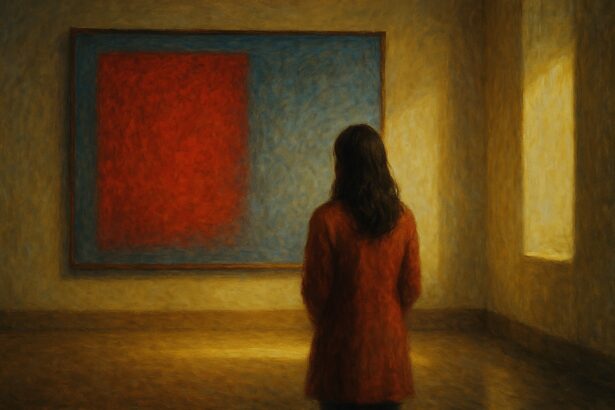
Pixels Fade, Paintings Stay — the thought returned to me on an ordinary afternoon, in a room that felt anything but ordinary.
It began with a painting that caught me unguarded. I had seen it before — in catalogues, online portfolios, even as a postcard tucked somewhere between books. One of Kavita Nayar’s works from her Story of Shimul Transcending series. But standing before it at the Visual Arts Gallery at Delhi’s India Habitat Centre, everything shifted.
The red looked deeper this time. The bluish-grey behind it felt quieter, almost meditative. Even the room had a pulse — a stillness wrapped in light. For a few suspended seconds, the chatter of the world dissolved.
“We are like flowers. We bloom, wither, and return. Our souls too transcend into another world, only to be born again. Just as flowers do each season,”
Kavita Nayar told me once. Suddenly, those words felt embodied on the canvas. When I stepped back into the street, the hush stayed with me — that rare, reverent silence that only art can summon. It made me wonder: why do we still walk into galleries when everything glows on a screen?
“Painting is poetry you see rather than read. It is a connection that soothes,” Nayar says. She recounts being invited to Rashtrapati Bhawan as an artist-in-residence.
“I created a three-panel mixed-media work there. President Murmu took the time to visit the exhibition in person. She could easily have seen it digitally, but she chose to be there and see them.”
That choice — to be physically present — feels increasingly rare in a world where everything clamours for speed. Perhaps that is why Srija Biswas, a first-year Statistics student at St. Xavier’s University, Kolkata, visits galleries between semesters and deadlines.
“Maybe because our eyes are tired. From scrolling, from chasing, from seeing too much too fast. A gallery asks for the opposite. It invites you to pause, to stay, to look, not for a second but long enough to feel something stir,” she says.
Even collectors are leaning into this.
“People do not just visit galleries, they are buying art again,” says Rajarshi Bhattacharya, premium art collector. “Many are drawn by aesthetic pleasure. But also by a deeper need to step away from the digital world. Collecting becomes a way to stay connected to something real… to artists, to history, to beauty that endures beyond a screen.”
Screens can move us, yes. But art in a room moves differently. It breathes around you. It shapes silence. It demands presence, something our lives are starved for. And perhaps that is what the younger generation is rediscovering — the sensory truth of being somewhere real. The echo of footsteps. The faint smell of paint. A beam of sunlight on a sculpture. The intimacy of walls holding colour, shape, and memory.
It is the same quiet movement we see everywhere: people baking bread again, touching clay, travelling without posting, watching the sky just because. A return to tactile life. A reawakening of the senses. Art steadies us. It slows us. It reminds us that not everything meaningful can be saved as a JPEG.
That moment before Nayar’s painting felt almost sacred. It wasn’t just the pigment or the composition — it was presence. Mine and hers. A silent meeting across time. And somewhere in the hush, something inside me aligned.
Maybe that is why we keep returning to galleries. To paintings, to music, to objects that don’t require Wi-Fi to reach us. Each time we stand before something real, we recover a small part of ourselves. And the heartbeat we sense on the canvas? Sometimes, it is simply our own.
