
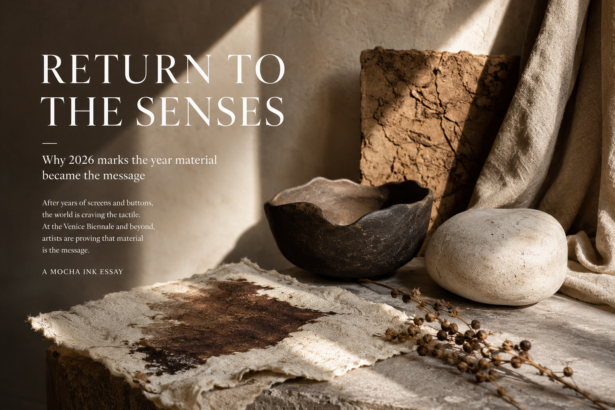
Why 2026 marks the year material became the message
For the better part of two decades, we have lived through the reign of the screen.We tapped, swiped, pinched, clicked and scrolled our way through work, leisure, relationships and culture. Art, too, became increasingly mediated, experienced through glowing rectangles before it was encountered in galleries, museums or artists’ studios. We learnt to consume masterpieces as thumbnails and exhibitions as Instagram carousels.
In 2026, the pendulum has begun to swing.
The world’s most compelling cultural conversation is no longer about the next technological leap. It is about something far older, quieter and infinitely more human: touch.
Material is the message.
It is the defining idea running through this year’s global art calendar, from the six-month Venice Biennale to international design fairs, gallery exhibitions and private collections. Artists are asking viewers not simply to look at a work but to experience its weight, texture, grain and memory. Wood is no longer just wood. Clay is no longer just clay. Bronze, linen, beeswax, volcanic ash, handmade paper and botanical pigments are becoming languages in themselves.
The shift is not a rejection of technology. It is a response to saturation.
After years spent pressing buttons and sliding across glass screens, the world is craving surfaces that resist us, materials that ask to be experienced rather than consumed.
At the 2026 Venice Biennale, In Minor Keys, conceived by the late curator Koyo Kouoh, this philosophy is quietly transformative. Rather than overwhelming visitors with digital spectacle, the exhibition invites them into spaces of reflection where texture, ritual, craft and embodied experience take precedence. It is less an exhibition than an exercise in attention.
The critic Adrian Searle of The Guardian once observed that “art begins where certainty ends.” It is an apt description of this Biennale, where certainty gives way to sensation and where the tactile becomes a form of knowledge.
Across the exhibition, materials seem to breathe with their own histories. Forged steel bears the memory of fire. Woven fibres retain the rhythm of the hands that made them. Oxidised bronze records the slow passage of time. Thick mineral pigments catch morning light differently from evening light, ensuring that no two encounters with the same artwork are ever identical.
These are experiences no screen can reproduce.
The cultural shift extends well beyond Venice. Collectors are increasingly commissioning heavily textured paintings, sculptural ceramics, woven tapestries and works created from reclaimed timber, earth pigments and handmade paper. Interior designers speak of “material warmth” as readily as they once discussed colour palettes. Luxury is being redefined—not by polish, but by presence.
As Wallpaper recently observed in its coverage of contemporary design, today’s audiences are seeking “objects with soul rather than objects with spectacle.” The phrase captures a broader fatigue that extends beyond art. We live in an age of frictionless interfaces, algorithmic recommendations and AI-generated perfection. Ironically, it is this very perfection that has made imperfection feel luxurious.
A visible brushstroke has become a mark of authenticity.
An uneven ceramic glaze feels more precious than industrial precision.
A crack in stone speaks of geology rather than defect.
The hand has become the new signature of value.
Even technology has contributed to this return. Artificial intelligence can now generate breathtaking imagery in seconds, yet the rise of AI has only heightened appreciation for works that bear the unmistakable traces of human labour. Time, patience and craft have become cultural currencies.
The design writer Alice Rawsthorn has long argued that materials are never neutral; they carry social, environmental and emotional consequences. In 2026, artists are embracing that truth with renewed conviction. They are working with reclaimed fishing nets, volcanic ash, fungi, oxidised metals, natural fibres and botanical dyes not simply because these materials are sustainable, but because they already possess stories.
Every material arrives with a biography.
Perhaps this is the deepest lesson of the year. We have spent decades designing technologies that eliminate friction. Yet the experiences that move us most are full of it, the roughness of linen, the cool density of bronze, the grain of oak, the softness of handmade paper, the scent of beeswax lingering in a gallery.
These are not merely aesthetic pleasures. They reconnect us with our own bodies. The future of art, it turns out, is not less technological. It is more sensorial. It understands that while images may circulate endlessly, material remains irreducibly real.
In a culture exhausted by screens and buttons, the world’s greatest artists are inviting us back to our oldest intelligence the intelligence of the senses.
And perhaps that is the quiet revolution of 2026: after years of asking what technology can do for art, we are once again asking what art can do for being human.
