
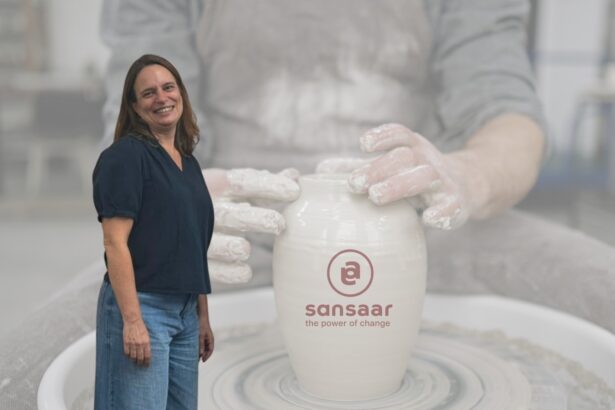
A little before the Noida International Airport became operational, its former CDO, Nicolas Schenk of Zurich Airport International, left India. The family home in Delhi was being packed up, memories folded into cartons, and one chapter of life was making way for another. It was around then that I caught up with his wife, Rebecca Haug.
Meeting Rebecca was supposed to be about a potter meeting another and finding a lot to talk about, but it ended up as a lesson on purpose. An understanding of the deeper art of leaving.
Over a warm embrace and a freshly brewed cup of coffee, we sat inside Sansaar, Rebecca’s home-based pottery studio in Delhi. It was a room filled with quiet shelves lined with clay vessels, unfinished pieces waiting to be fired, tools that had witnessed years of patient creation. The house was preparing for departure, but the studio still pulsed with life.
While her husband was helping build an airport that would transform mobility across the NCR, Rebecca had been building something equally enduring: a community. Sansaar began simply as a personal practice, a love affair with clay. But like most meaningful things, it grew organically.
It became a gathering place for people who wished to create, to learn, to slow down and reconnect with their hands and with one another. Teachers arrived, students followed, and soon a creative ecosystem had taken root at the Swami Sivananda Memorial Institute of Fine Arts and Crafts (SSMI) in New Delhi, an institution founded more than six decades ago to empower women and children through education, skill development and social enterprise.
At SSMI, pottery sits alongside block printing, tailoring and traditional crafts, creating a vibrant ecosystem where heritage and livelihood meet. The institution stands as a reminder that craftsmanship is not merely about producing objects; it is about nurturing confidence, dignity and self-reliance. Every artisan who walks through its doors carries forward a legacy of resilience and possibility.
Rebecca has been especially passionate about encouraging young women to learn pottery and showcase their work at exhibitions, helping them recognise that what emerges from their hands carries both beauty and value.
“It started with practice and eventually became a place to bring together like-minded people who wanted to create,” she told me. “Soon, we had teachers and students, and Sansaar became a community.” What struck me most, however, was her philosophy of making. “There is too much pressure on potters to master the wheel,” she said. “Hand-built plates and vessels are true art. They have character. They carry the imprint of the maker.” There was something deeply liberating in that thought.
We live in a world obsessed with perfection, speed and symmetry. Pottery teaches us something entirely different. It asks us to embrace imperfection, to trust process over outcomes and to honour the beauty of what is uniquely human. Every hand-built vessel bears the marks of its creator. No two are identical. The slight unevenness, the fingerprints, the organic lines they are not flaws but signatures of authenticity. And perhaps that is true of human beings as well. There is an old wisdom among potters: as the hands shape the pot, the pot shapes the potter. The relationship is never one-sided. Clay teaches patience because it cannot be hurried. It teaches surrender because it resists control. It teaches humility because the earth always has the final word. In working with clay, one learns to listen, to adapt and to trust the process of becoming.
The vessel emerges stronger after the fire, but so does the person who made it. That, perhaps, is the transformative power of pottery. At SSMI, the act of shaping clay becomes an act of shaping lives. Confidence grows with every finished piece. Community is built around shared creativity. Women discover not only a craft but also a sense of agency, purpose and belonging. The hands create the pot, but the pot, in turn, creates patience, resilience and self-worth.
When Rebecca left New Delhi for Switzerland, she did not leave an absence, but a legacy. And for me? A rekindled urge to return to my passion for clay.
You can follow Rebecca’s art and work at www.sansaar.ch
