
There was a time when gold meant certainty.
It rested in family vaults, travelled through generations wrapped in silk, and lived on women’s bodies as inheritance, security, and status. Across India, mothers measured stability in bangles. European monarchies displayed dynastic power through diamonds and crowns. In the Middle East, gold became both ornament and currency. Jewellery was not simply decorative, it was economic language.
And yet one of fashion’s greatest revolutions began the moment designers decided that gold no longer needed to be real to possess power. Today, the irony is extraordinary: the global costume jewellery market once dismissed as imitation is valued at nearly USD 40 billion worldwide and projected to cross USD 63 billion by 2034. The industry is growing at over 5–7% annually, driven by fast fashion, celebrity culture, social media styling, and a generation more interested in visual identity than inherited permanence.
Fashion did not merely imitate gold. It invented a new kind of gold altogether.
The story begins long before couture houses entered the picture. In eighteenth-century Europe, aristocrats wore “paste jewellery” carefully cut leaded glass stones designed to imitate diamonds under candlelight. These pieces were practical substitutes at court events where wearing real gems carried risks of theft or damage. Even then, illusion had already begun rivaling authenticity.
But imitation jewellery still apologised for itself. It existed in the shadow of the real thing.
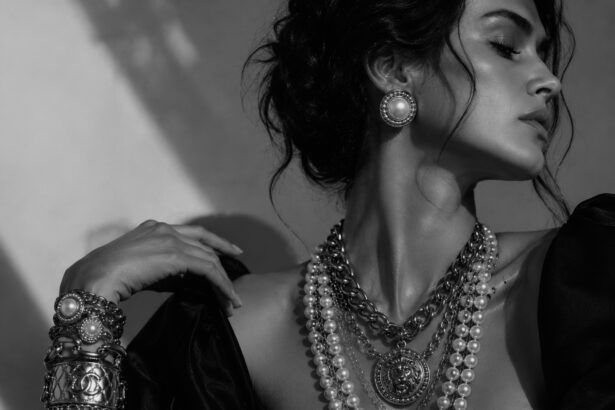
Then came Coco Chanel. In the 1920s, Chanel quietly dismantled centuries of jewellery hierarchy with one radical styling choice: she layered ropes of faux pearls over minimalist couture and wore them unapologetically. Until then, jewellery had been evaluated by material worth. Chanel evaluated it by aesthetic impact.
This changed fashion forever. Chanel’s gilt Byzantine crosses, enamel cuffs, oversized chains, and imitation pearls became more culturally influential than many royal jewel collections. Her genius lay in understanding that jewellery could frame personality rather than merely display wealth. Fashion had discovered emotional luxury.
Soon the great couture houses followed. Dior created theatrical crystal necklaces in the 1950s that shimmered spectacularly under runway lights. Yves Saint Laurent transformed hammered gold cuffs and Byzantine medallions into symbols of intellectual glamour. Chanel perfected its now-iconic visual language of molten antique gold, lion motifs, camellias, quilted charms, and baroque chains.
These houses were not attempting to replicate precious jewellery. They were creating fantasy systems. The craftsmanship behind this fantasy was remarkable. Parisian ateliers such as Maison Gripoix mastered pâte de verre hand-poured glass jewels glowing with cathedral-like luminosity. The pieces possessed irregularity and depth impossible in mass-produced jewellery. Ironically, objects made from glass and gilt metal began acquiring artistic value equal to fine jewellery.
Hollywood elevated costume jewellery into global mythology.
Studio executives realised that faux stones often looked better on camera than real diamonds. Large crystals reflected light dramatically under harsh film lighting, while oversized pieces framed actresses’ faces more effectively. Costume jewellery became central to cinematic glamour.
The image of Marilyn Monroe dripping in dazzling faux diamonds while singing “Diamonds Are a Girl’s Best Friend” permanently altered the visual culture of luxury. Audiences were not interested in authenticity. They were interested in aspiration.
Then came Audrey Hepburn in Breakfast at Tiffany’s, wearing crystal and pearl costume jewellery with effortless sophistication. That image became immortal because women everywhere could recreate it. Fashion was democratising glamour.
Perhaps no designer understood this better than Kenneth Jay Lane. Lane created oversized faux emeralds, coral earrings, serpent bracelets, and dramatic necklaces so theatrical that royalty themselves wore them openly. Jacqueline Kennedy Onassis frequently wore his imitation pearls. Elizabeth Taylor, owner of some of the world’s most extraordinary diamonds mixed real and fake jewellery effortlessly because she valued spectacle over hierarchy.
Lane famously said, “The rich wear real jewellery the first time and fake jewellery the second.”
That sentence captured a cultural shift larger than jewellery itself. Fashion was moving away from inherited status toward curated identity. Today, the numbers reveal just how complete that transformation has become.
Asia-Pacific now dominates over 30% of the global costume jewellery market, fuelled heavily by India and China as both manufacturing and consumption hubs. Online retail and social media influence are accelerating growth dramatically. Reports suggest nearly 55% of current market influence comes from digital and online fashion ecosystems, while 42% of consumers actively seek personalised or trend-responsive jewellery.
The modern consumer no longer buys jewellery only for permanence. They buy it for transformation.
This is especially visible in India, where costume jewellery evolved not in opposition to gold culture, but alongside it. Cinema played a defining role. The regal adornments worn by Madhubala, Sridevi, and Rekha created enormous demand for accessible grandeur. Entire markets emerged around recreating royal aesthetics through kundan-inspired chokers, faux polki sets, temple jewellery, and meenakari-inspired pieces.
Costume jewellery became aspirational storytelling.
It allowed women to inhabit cinematic identities without requiring royal inheritance.
Meanwhile, rising gold prices continue reshaping consumer behaviour globally. Luxury houses increasingly focus on emotional experience, archival storytelling, and aesthetic identity rather than pure material value.
In many ways, fashion achieved something radical: it detached glamour from geology. Today, some vintage costume jewellery pieces command astonishing resale values. Chanel cuffs, Dior crystal necklaces, and rare Kenneth Jay Lane creations are auctioned as collectible fashion history. What was once dismissed as “fake” now carries cultural permanence.
And perhaps that is because fashion ultimately changed the definition of luxury itself. Gold once derived power from scarcity. Fashion gave it another source of power: imagination. The jewellery we remember is rarely remembered for its karat count. We remember it because it framed a woman becoming someone larger than herself cinematic, sensual, intellectual, rebellious, untouchable.That is the true legacy of jewellery beyond gold.
Fashion houses did not merely create imitation jewellery. They created emotional gold adornment powerful enough to outlive the material it was made from.
We are on the gram @mochaone.live
