
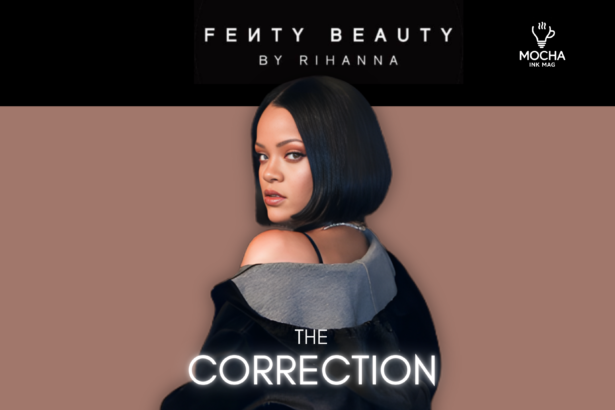
There are brands that launch. And then there are brands that arrive like a reckoning. Fenty Beauty did not enter the room quietly. It held up a mirror, forty shades deep, unapologetically expansive, and asked a question the beauty industry had been dodging for decades. Who gets to be seen?
For too long, beauty counters across the world operated on a silent hierarchy. Fair was first. Medium was manageable. Deep was an afterthought, if it existed at all. The message was subtle but brutal. Visibility had a shade limit. Across continents, from South Asia’s obsession with fairness creams to Western media’s erasure of deeper tones, skin was coded with value. Lighter meant aspirational. Darker meant invisible, or worse, undesirable. Entire industries thrived on this hierarchy, selling not just products but aspiration tied to proximity to lightness.
And then came Rihanna.
Not merely a global pop icon or fashion disruptor, but a cultural strategist who understood something fundamental. Beauty is not just aesthetic, it is political. Skin tone is not just pigment, it is history, power, access, and exclusion. With Fenty Beauty, she did not just launch a product line. She rewrote the baseline. Forty shades was not a marketing gimmick. It was a statement of intent. It signalled abundance where there had been scarcity. It said you are not an edge case, you are the centre. In a single move, Fenty shifted the conversation from inclusion as charity to inclusion as standard. That distinction is everything.
What made it powerful was not just the range but the precision. Undertones mattered. Nuances mattered. It was not a token gesture of “we have dark shades too.” It was a meticulous, obsessive commitment to getting it right. For the first time, millions of people did not have to mix, adjust, or compromise. They could match. And in that act of matching, something deeper happened. Recognition. To find your exact shade on a shelf is not a small thing. It is a moment of validation that says you were considered. Your skin was not an afterthought. You belong here.
This is where Fenty Beauty becomes more than a cosmetic brand. It becomes a cultural correction, forcing legacy brands into uncomfortable introspection. Why had they ignored this spectrum for so long? Why did inclusivity suddenly become urgent only after Fenty proved it was profitable? The industry scrambled, expanded ranges, issued statements. But the truth lingered. This was not innovation, it was overdue accountability. Rihanna did not just create a product. She exposed a blind spot. And she did it with an effortless sensuality where power is not loud but undeniable, where disruption is wrapped in elegance, where the message is clear without being didactic. Beauty is not a narrow corridor, it is an expansive landscape.
Then came the misstep. In August 2025, Fenty Beauty released an advertisement for the Indian market that landed with a thud. The thirty second reel showed Rihanna entering a taxi, blowing a kiss at the camera as the driver watched her lips through the rear view mirror. Set to Arabian music, framed as playful and bold, the ad was meant to sell gloss. Instead, it sold a nightmare. Indian women did not see flirtation. They saw every cab ride home where a man’s eyes in the mirror meant fear, not fantasy. One user wrote, “This is my worst nightmare. A cab driver looking at me through the rearview. Why are people encouraging it?” Another said, “Now harassment is romanticized. Very poor execution.” The backlash was swift, sharp, and deeply felt, not because women wanted to hate Fenty, but because they had hoped for better from a brand built on the promise of seeing women fully. That was the blind spot. And it is precisely why what came next matters so much.
In April, Rihanna did something remarkable. She returned to Mumbai, not with a press release, not with a defensive statement, but with a haveli. Fenty Beauty Ki Haveli opened at Phoenix Palladium, a pop up that was less a retail space and more a cultural immersion. Arched doorways, tiled floors, a powder room for shade matching, a drawing room for block printing tote bags, and a gathering room with a kulfi cart that smelled faintly of dessert. Rihanna herself arrived, greeted fans with a warm “Namaste Mumbai,” and later learned to say “shukriya” for the waiting paparazzi. She moved through the space not as a distant celebrity but as a collaborator, reworking video takes with creators, trying Bharatanatyam steps, and personally calling out shade numbers when someone mentioned struggling to find a match. She said, half joking and fully committed, “No one is looking ashy or orange on my watch.”
That is what was missing from the taxi ad. Not good intentions, but lived understanding. The ad assumed a universal language of glamour, forgetting that for Indian women, a stranger’s gaze is not a compliment. It is a calculation of safety. The haveli, by contrast, assumed nothing. It listened. It asked. It built a space where women could see themselves without having to first explain why they needed to be seen.
Rihanna said it best herself in an interview at the haveli. She told Vogue India, “Women just want to be seen. It’s as simple as that. We just want to be seen, to be known, to be heard. We want our visions and ideas to mean something.”
Now consider India itself. The world’s largest consumer of fairness creams. Let that land. A country of over a billion people with some of the most glorious, varied, melanin rich skin tones on earth, and its bestselling beauty product for generations has been lightening lotion. The colonial wound runs deep. Lighter skin means marriage prospects, job prospects, social mobility. Darker skin means comments at wedding functions, filters before photo uploads, a lifetime of being told “you’re pretty for a dark girl.”
Into this landscape walks Rihanna, not as a salesperson but as a mirror. When Fenty Beauty lands on Indian shelves, on Indian Instagram feeds, on the faces of women who finally see themselves, it does not just sell foundation. It offers a quiet, devastating alternative to a century of shame. It says you do not need to lighten. You need to be seen. And that is poetic justice of the highest order because colonialism taught India to hate its own skin. Here is a Black woman from Barbados, herself a child of colonial history, herself from an island that knows the weight of empire, handing back what was stolen, not with lectures or NGO campaigns but with forty shades of unapologetic presence. Every time a young woman in Delhi or Mumbai or Kolkata finds her exact shade and does not mix it with a lighter one, that is a small, private revolution. Every time a mother watches her daughter refuse fairness cream because “Rihanna has my colour,” that is history unlearning itself.
Fenty did not just expand shades. It expanded imagination, making it impossible for the industry to return to its old defaults. Once you have seen forty shades on a shelf, ten feels like erasure. Once you have experienced precision, approximation feels lazy. The bar has moved and it is not coming back down. In many ways, Fenty Beauty settled a quiet score, not through outrage but through proof. It demonstrated that true luxury is not about exclusivity anymore but about recognition. In a world still negotiating its relationship with colour, identity, and visibility, that might just be the most powerful shade of all.
The taxi ad was a misstep. The haveli is an apology, not spoken but built. In the architecture of that apology, in the kulfi and the block printing and the patient shade matching, Rihanna proved that when a brand truly wants to see a woman, it does not need to manufacture a gaze. It just needs to show up, listen, and hand her the gloss. Then step back and let her shine.
Rihanna’s true contribution is not a product line. It is a permission slip. She gave the world permission to stop apologising for its own skin. She gave the beauty industry permission to stop being afraid of the dark. And in India of all places, a country drowning in fairness creams and colonial scars, she gave a postcolonial society the most radical gift imaginable. You are enough. No mixing required. No lightening necessary. No need to shrink yourself to fit a shelf that was never built for you.
That is not marketing. That is medicine. And it tastes like gloss, smells like kulfi, and looks like forty shades of unapologetic, undeniable, utterly elegant reckoning.
