
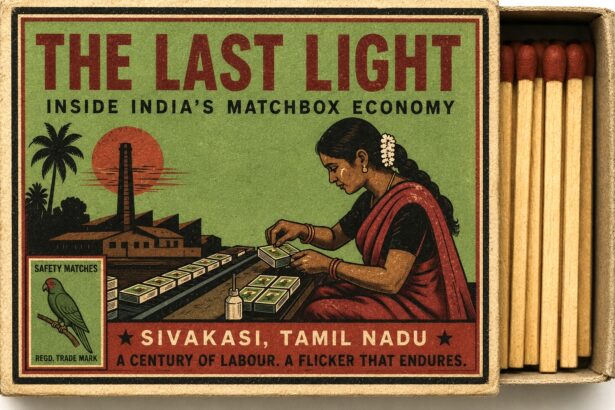
Every Indian kitchen has one.
A small cardboard box tucked beside the gas stove. It costs less than a cup of tea, survives in the darkest corners of cupboards and drawers, and is rarely given a second thought. Strike. Flame. Forget.
Yet behind that quiet flicker lies one of India’s oldest manufacturing stories, one built on women’s labour, family-owned factories, changing technology and a century-long struggle to stay relevant in a world that increasingly prefers the click of a disposable lighter.
The story begins not in Sivakasi but in Calcutta.
In the early twentieth century, Japanese entrepreneurs introduced modern match manufacturing to the city. Inspired by what they saw, two young brothers from Tamil Nadu’s Nadar community, Ayya Nadar and Shanmuga Nadar, travelled north to learn the trade. They returned home in 1922 and laid the foundations of what would become India’s matchbox capital.
A year later, Swedish-backed WIMCO established a large factory near Bombay and went on to dominate the organised market for decades. Sivakasi chose a different path.
Instead of one industrial giant, hundreds of small and medium manufacturers emerged, creating a tightly knit industrial ecosystem that spread across neighbouring towns such as Sattur and Kovilpatti. That decentralised model remains the industry’s defining characteristic even today.
Collectively, the region continues to produce the overwhelming majority of India’s safety matches. Industry estimates place around 220 manufacturing units in Sivakasi, another 230 in Sattur and about 215 in Kovilpatti. Together they form the country’s matchbox heartland.
Walk through these factories and another pattern becomes immediately evident.
The industry runs on women.
More than ninety percent of the workforce consists of women who perform the painstaking tasks of label pasting, bundle packing and box filling. Even as production has become increasingly mechanised, these final stages remain difficult to automate economically, making human hands indispensable.
But the economics of those hands have become increasingly fragile.
For years, the humble matchbox remained frozen at a retail price of one rupee. When manufacturers finally doubled the price to two rupees in October 2021, it offered temporary relief but not a lasting solution. The industry’s real challenge was no longer inflation. It was irrelevance.
Disposable plastic lighters, many imported cheaply from China, have steadily replaced matchboxes in urban households. Overseas, Indian exporters have also found themselves squeezed by lower-cost competitors such as Indonesia and Pakistan, particularly after the pandemic reshaped global supply chains and buyer relationships.
Recognising the strain, Tamil Nadu Chief Minister M.K. Stalin wrote to the Union Commerce Ministry in September 2022 urging a ban on imported single-use plastic lighters, describing the domestic match industry as passing through a “difficult phase.”
On the ground, the pressure is visible.
By early 2025, local reports suggested the once-sprawling cluster had contracted to roughly 300 largely mechanised factories supporting nearly three lakh people directly and indirectly. Employment remains substantial, but the nature of work has changed.
Workers in mechanised factories earn around ₹370 a day, while those employed in manual units often receive barely ₹100. Migrant workers who once travelled to Sivakasi for employment are increasingly leaving in search of better-paying opportunities elsewhere.
No history of Sivakasi, however, is complete without confronting its darkest chapter.
For decades, the town’s prosperity was shadowed by child labour.
In 1981, children between four and sixteen years of age reportedly made up nearly thirty percent of the industry’s workforce, with girls accounting for almost ninety percent of them. A 1986 National Child Labour Project survey documented more than 14,000 children employed in match-making units, many belonging to Scheduled Caste communities.
The years that followed brought sweeping reforms.
The National Policy on Child Labour introduced rehabilitation measures in 1986, while a landmark Supreme Court judgment in 1996 strengthened employer accountability through compensation and welfare provisions. Factory owners today maintain that registered units no longer employ children, although labour organisations continue to caution that monitoring home-based and informal operations remains far more difficult.
Ironically, what began as a human-rights intervention also became an industrial turning point.
J. Devadoss, Secretary of the South India Match Manufacturers Association, has argued that once child labour disappeared and schooling became compulsory, manufacturers had little choice but to invest in semi-mechanised and mechanised production. India’s economic liberalisation in the 1990s accelerated that transition, reshaping the industry’s economics for a new era.
A century after its founding, Sivakasi still produces the flame that lights millions of Indian homes. WIMCO was later acquired by ITC which built its own line of designs like AIM, Homelites, Dazzle and more – while adding a modern graphic twist to India’s traditional matchboxes.
The matchbox industry finds itself suspended between two worlds – too traditional to compete with cheap imported substitutes, too labour-intensive to deliver the margins modern manufacturing demands, yet too culturally embedded to disappear overnight.
However, the matchbox endures.
Not because it is the most efficient way to create a flame, but because it carries within its thin cardboard walls the story of an industrial town, generations of women workers, remarkable entrepreneurial resilience and a manufacturing ecosystem that has quietly survived every economic shift India has experienced over the last hundred years.
The next time a match flares to life in your kitchen, it is worth remembering that the smallest light often illuminates the longest story.
Mocha Business Features are reflective essays in the intersection of nostalgia and economics.
