
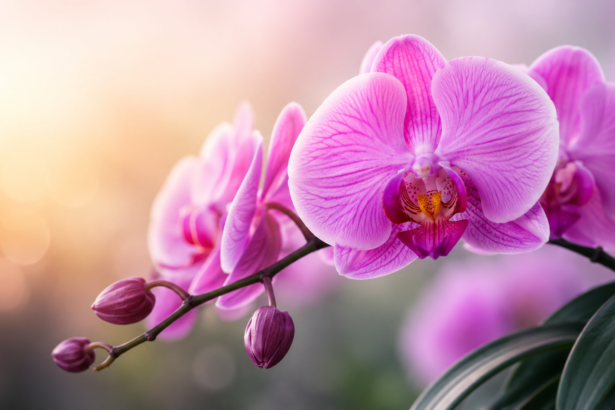
In the mist above Gangtok, a flower that once grew wild for no one’s benefit now travels the world. How did it get there?
A particular stillness settles over East Sikkim in the hour before dawn, when the mist has yet to lift from the ridgelines and the polyhouses stand shuttered in the dark. Within them, something has been assembling itself for twenty years: not with the fanfare of a tech unicorn or the ceremony of a factory ribbon-cutting, but with the patient, compounding discipline of a state that chose to wager on its own biodiversity rather than import someone else’s blueprint. That wager is now maturing into returns, and its ledger is unusually legible for an agricultural transformation. Sikkim’s orchid exports rose 40 percent in the past year alone, propelled by surging global demand for Cymbidium, Dendrobium, and Vanda varieties. Demand, once it arrives, arrives quickly. The more instructive question is what delayed it for so long, and what Sikkim occupied itself with in the interim, while most places do nothing of the kind.
The improbability of this outcome bears dwelling on. Twenty years ago, Sikkim’s orchids were precisely what most of India’s orchids remain today: a wild, dispersed, undercapitalised botanical inheritance, admired but unmonetised, cultivated in a state defined by mountainous terrain, an absence of rail access, and a monsoon capable of severing roads for weeks at a stretch. The state harbours more than five hundred native orchid species, Dendrobium Nobile, its delicate state flower, foremost among them, placing it second only to Arunachal Pradesh in national orchid diversity. Yet biodiversity alone has never constituted a business model. Were it sufficient, Arunachal Pradesh, endowed with greater orchid diversity still, would be the one exporting at scale. Instead, its anthurium trade has contracted in recent years for want of precisely the scaffolding Sikkim spent two decades quietly erecting. The flowers were never the difficult part. The infrastructure surrounding them was, and so too was the labour force cultivated to sustain it.
That scaffolding merits precise articulation, for it is the portion of the story least suited to photography, and therefore the portion most often omitted, despite arguably being the true engine behind Sikkim’s figures. In 2016, Sikkim became India’s first fully organic state, a designation less slogan than mechanism, one that quietly reconfigured the entire flower trade by converting “pesticide-free” from an environmental footnote into an export credential for which buyers in the UAE and Japan willingly pay a premium. Around that certification, the state cultivated human infrastructure in advance of physical infrastructure: polyhouse cultivation suited to Sikkim’s unusually cool summer nights, ICAR’s National Research Centre on Orchids embedded directly within the state to train growers in production and disease protection, and SIMFED, the state’s own sales network, constructed so that individual farmers need not become their own logistics enterprises.
What distinguishes this undertaking from comparable floriculture initiatives elsewhere in the Northeast is the question of who was entrusted to lead it. Sikkim’s orchid economy is, by a considerable margin, a woman-led enterprise. Nearly half of the state’s orchid farmers are women, a proportion with scarcely any parallel in Indian commercial agriculture, where women’s labour remains overwhelmingly informal, uncredited, and rarely attached to ownership of either crop or land. This outcome was engineered rather than incidental. The Kisaan Sakti Yojana, a state scheme conceived expressly for women farmers, has channeled training, tools, and subsidies into horticulture and organic cultivation alike.
Self-help groups served as the operational unit through which that support reached the field in practice: pooling resources, disseminating agronomic knowledge, and conferring on women a collective bargaining position with buyers and state agencies that individual smallholders rarely command alone. Government clusters have distributed planting material directly through these groups, five hundred saplings apiece to fifty farmers across eighteen clusters in recent programs. The effect compounds over time in a manner no single subsidy could replicate: research on self-help groups within Indian agriculture finds they meaningfully expand women’s access to information and their voice in farming decisions, even where the effect on yield and income proves harder to isolate with precision.
Sikkim’s case suggests that when such organising labor is sustained across two decades rather than confined to a pilot project, income eventually follows, unevenly but discernibly. The consequence of this architecture is a value chain extending from a five-hundred-square-foot polyhouse plot, financed for as little as sixty-seven thousand rupees, to florets retailing at twenty to a hundred and fifty rupees apiece in markets, Delhi, Kolkata, and increasingly beyond, that would never have known Sikkim’s name a generation ago.
Somewhere along that chain, a farmer such as Anuradha Chettri of Upper Namcheybong, honoured with the Pandit Deen Dayal Upadhyay Antyodaya Krishi Puraskar for converting orchid cultivation into a livelihood, becomes less an exception than a template, even as her recorded annual revenue of roughly thirteen thousand rupees serves as a sobering reminder of the distance still separating the cultivation of excellent orchids from reliable profit upon them. Nationally, floriculture’s share of India’s horticultural output has climbed from under one percent a decade ago to roughly twelve percent today, a tailwind Sikkim has ridden disproportionately well. Yet the state’s own cultivation area has remained essentially static for a decade, holding near two hundred and forty-two hectares, its total annual output valued at a mere two crore rupees, a rounding error against India’s roughly thirty-two-thousand-crore floriculture market writ large. A cold-chain facility sized to process just twenty-two and a half tonnes of orchids daily was recently costed at three and a quarter crore rupees, a figure that lays bare how much capital intensity still separates Sikkim’s export surge from its capacity to fulfill it. This is a revolution still mid-sentence, its conclusion yet unwritten.
Therein lies the more instructive account, for any reader approaching this as an economic case rather than a feel-good dispatch: not a problem resolved, but a living study of a place that erected unglamorous scaffolding years before the market rewarded it, staffed substantially by women whose formal participation in agriculture was itself a deliberate policy choice rather than an incidental byproduct, and is now watching that patience convert, unevenly yet unmistakably, into genuine export demand. There is reason enough to study this modest mountain economy well beyond its balance sheet. Sikkim’s achievement was never truly about orchids.
It concerns what transpires when a place declines to imitate a neighbour’s growth model and instead inquires, with genuine discipline, what it alone possesses, then constructs the institutions, substantially governed by women, to capture the value of that answer. Sikkim did not outproduce its rivals. It outorganised them, and when the world’s appetite for something rare and organic finally caught up, the workforce assembled to meet it was already standing ready.
Mocha Business captures the essence of business and economy in the long form.
