
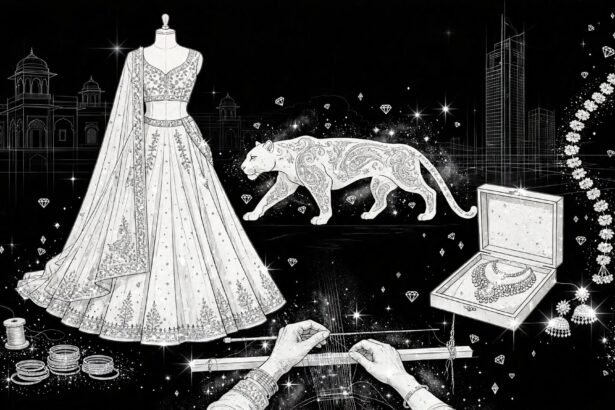
India is authoring its own luxury; thanks to heritage.
For centuries, European luxury built its authority through history. It looked backwards to Greek temples, Roman architecture, Renaissance proportion, royal courts and centuries of accumulated craftsmanship and transformed the past into a vocabulary of refinement. History became a sourcebook: something to study, distil and reinterpret. Luxury was often the language of that translation.
India has always possessed another kind of archive. Not simply history, but heritage. The distinction matters. History is something we remember. Heritage is something we continue.
A weaving technique passed from grandmother to granddaughter is not merely a historical reference. It is living knowledge. A wedding ceremony that still gathers families around colour, jewellery, ritual, food and music is not a reconstruction of the past. It is a living tradition. A richly embroidered textile is not necessarily decoration. A jewel can carry lineage. The scale of an Indian celebration is not always excess; sometimes it is the meaning of the celebration itself.
For decades, however, the global luxury system encountered Indian aesthetics largely through translation. Indian colours, embroidery, mythology, jewellery and maximalism were admired, borrowed and reinterpreted through established Western codes. India could be inspiration. It could be exotic. It could be beautiful. But it rarely got to be the author.
That relationship is changing.
And the significance of India’s luxury boom lies not simply in how much Indians are spending. It lies in who is defining what luxury looks and feels like. India’s luxury market is growing rapidly, with estimates varying according to what is included, and Deloitte projecting it could reach around $30 billion by 2030. But the more interesting story is happening inside the numbers: Indian houses are demonstrating that cultural specificity itself can become a source of global luxury authority.
Consider Sabyasachi. The Calcutta designer has built something far larger than a fashion label: a universe of couture, jewellery, art, interiors and storytelling in which Indian visual abundance is not toned down to appear sophisticated. His business reached roughly ₹500 crore in FY25 and about ₹650 crore in FY26. Yet the numbers are less interesting than what they represent. Sabyasachi has shown that Indian luxury does not have to become restrained, minimalist or European in order to become international. It can travel precisely because it is unmistakably itself.
Manish Malhotra represents another expression of this confidence. For years, being described as a “Bollywood designer” could sound like a qualification rather than a credential. But Malhotra understood something fundamental about Indian glamour: spectacle is not necessarily superficial. The Indian wedding, with its colour, scale, embroidery, jewellery and theatricality, is not simply a fashion opportunity. It is a cultural system. Malhotra’s label reported revenue of about ₹308 crore in FY25, but his larger contribution has been to make Indian celebration a legitimate language of luxury rather than something that needed to be edited into European restraint.
Anita Dongre offers a different model, connecting contemporary fashion with craft, sustainability and the revival of traditional knowledge. Her business has operated at significant scale, demonstrating that heritage need not remain confined to museums or artisanal enclaves. It can become commercially viable without losing its connection to the communities and techniques that give it meaning.
Together, these designers reveal something important: Indian luxury does not have one aesthetic. It can be maximalist, cinematic, artisanal, sustainable, contemporary or deeply traditional. What connects these seemingly different worlds is ownership of the cultural source.
This is why India’s luxury story should not be framed simply as India “catching up” with Europe. European luxury has its own extraordinary history and institutional power. India does not need to replace it. Something more interesting is happening: the hierarchy of luxury is becoming plural.
Luxury has always been about scarcity, craftsmanship and status. Increasingly, it is also about meaning. And meaning is difficult to manufacture when it has no living connection to the culture from which it comes.
Heritage can certainly be reinterpreted. It should evolve. But translation inevitably changes what it carries. India’s emerging luxury houses are no longer asking to be admitted into an existing definition of luxury. They are quietly expanding the definition itself. India is moving from inspiration to authorship.
And perhaps that is the real luxury story of the next decade: not that India will become the next Paris, but that it will have no reason to.
History can be studied. Heritage has to be lived.
