Every era invents its own heaven.
The agrarian age dreamed of fertile kingdoms where harvests never failed. The Industrial Revolution imagined factories that would liberate humanity from physical toil. The twentieth century promised democracy, free markets, and the internet as engines of universal prosperity.
Now the architects of artificial intelligence are sketching a new paradise.
Within days of one another, two of the world’s most influential technologists offered visions that would once have belonged in speculative fiction.
Elon Musk, speaking with The Economist‘s editor-in-chief Zanny Minton Beddoes, argued that advances in artificial intelligence and robotics could, within a decade, create an economy of such staggering abundance that money itself becomes largely irrelevant. As autonomous machines produce goods and services at negligible cost, scarcity, the organising principle of modern economics begins to fade. Musk’s reasoning centred on a simple equation: if AI-driven output grows faster than the money supply, the result is deflation rather than inflation, and governments could expand the money supply without triggering runaway prices. He has floated a “universal high income” as the eventual policy response.
Days later, Sam Altman reached for an altogether older metaphor.
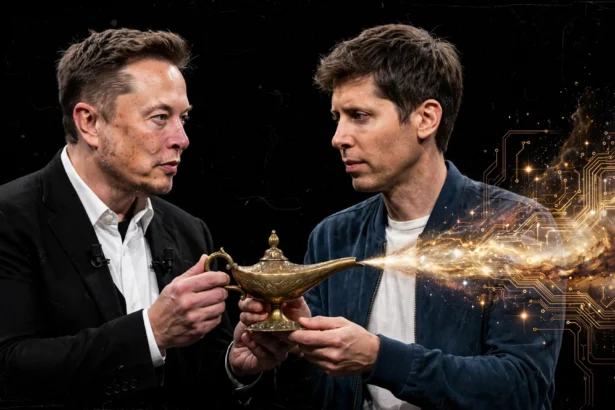
Speaking on the Relentless podcast, the OpenAI chief said the industry’s central task was to explain that humanity is “close to creating a genie that can grant any wish” an artificial intelligence capable of tackling problems once thought beyond human reach. His caveat was equally revealing: the first wishes, he said, should broadly benefit humanity rather than a privileged few, and the goal should be a world where “a lot more people get to have a lot more wishes.”
Listen to the two together and something profound emerges.
Silicon Valley is no longer marketing technology.
It is marketing destiny.
For half a century, the technology industry sold improvements smaller chips, faster processors, better software, more elegant devices. Today’s rhetoric is civilisational. It speaks not of products but of the end of scarcity, the democratisation of intelligence, and the redesign of the economic order itself.
This is perhaps the boldest narrative capitalism has produced since the dawn of the internet.
The remarkable thing is that the numbers no longer make these visions sound entirely implausible.
McKinsey Global Institute estimates that generative AI could contribute between US$2.6 trillion and US$4.4 trillion in economic value every year across industries. Goldman Sachs projects AI could lift global GDP by around 7% over the coming decade. The IMF’s Kristalina Georgieva has put the figure at up to 0.8 percentage points of additional annual global growth enough, she’s argued, to push growth back above pre-pandemic averages, if the technology is deployed thoughtfully.
These are not forecasts of utopia.
But they are evidence that the world’s largest economic institutions increasingly regard artificial intelligence as a general-purpose technology on the scale of electricity, the steam engine, or the internet.
And that is where the conversation becomes larger than Silicon Valley.
Every civilisation has imagined an object capable of granting limitless possibility. The Greeks had the Cornucopia. India imagined the Kalpavriksha, the wish-fulfilling tree. Arabic folklore gave us the genie in the lamp.
Each myth carried the same warning.
Power changes the person who possesses it.
The promise of AI is not merely that machines become more intelligent.
It is that intelligence itself becomes abundant.
When intelligence becomes abundant, economics begins to mutate.
When labour becomes optional, employment ceases to be society’s organising principle.
When knowledge becomes nearly free, expertise is redefined.
When creativity can be generated on demand, originality becomes immeasurably precious.
Scarcity does not disappear.
It migrates.
Time remains finite.
Attention becomes more valuable.
Judgement grows priceless.
Trust becomes a premium asset.
In an age where algorithms can generate infinite content, authenticity may become the ultimate luxury brand.
History, however, has an inconvenient habit of tempering technological euphoria.
Every revolution has indeed produced abundance.
The steam engine multiplied industrial output while deepening inequality during its early decades. Electricity transformed economies long before everyone could access it. The internet democratised information while concentrating extraordinary wealth among those who owned the platforms.
Technology has consistently expanded prosperity.
Institutions have determined who participates in it.
That distinction matters.
Neither Musk nor Altman is offering a prediction guaranteed to unfold exactly as described. Both are presenting aspirational visions from leaders building the technologies they believe will shape the future and both have considerable financial stakes in those visions being believed. Their optimism deserves attention, but also scrutiny.
The genie, after all, may grant extraordinary wishes.
Someone still owns the lamp.
Perhaps that is the defining paradox of our age.
The world’s most powerful technologists are inviting humanity to imagine a civilisation beyond scarcity, beyond repetitive work, and perhaps even beyond conventional economics. Whether those promises culminate in a renaissance of shared prosperity or a new concentration of wealth will depend less on artificial intelligence than on profoundly human choices competition, governance, education, ethics, and political imagination.
The twenty-first century may not ultimately be remembered for building machines that think.
It may be remembered for asking whether humanity was wise enough to decide what to wish for once almost anything became possible.
Someone Still Owns the Lamp