
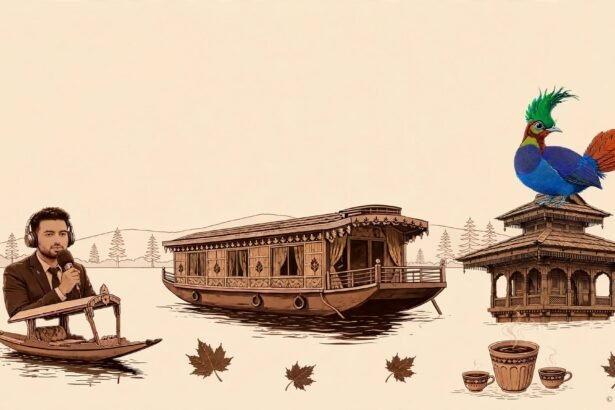
He started by making content in Koshur or native Kashmiri to keep the language alive among the young ones. But soon, he became a tutor for the Kashmiri diaspora, keen on cultural preservation. Meet Saqib Mukhtar, a student of Law from Anantnag who has turned a social-media passion to a profession. Saqib is a Koshur tutor on an international language platform where he has completed more than 100 hours of classes for students who are getting back in touch with the language of the Valley. He thinks there is a growing enthusiasm for preservation of the language. Here’s what he shared with Mocha Ink Mag.
Mocha: What makes Koshur unique among South Asian languages? What linguistic or cultural elements would be lost if it disappeared?
S. Kashmiri, (Koshur), is a Dardic language within the Indo-Aryan branch of the Indo-European language family. Other Dardic languages include Shina, Kalasha, Khowar, Pashayi, and Kunar. Kashmiri has a number of linguistic features that make it unique in South Asia. One is its basic V2 word order, which is not present among Indo-Aryan languages and is more commonly associated with languages such as German and other Germanic languages.Kashmiri also has a unique vowel system, including vowel sounds that are not found in neighboring languages in the same way. Its vocabulary reflects centuries of contact with different cultures and languages, including Sanskrit, Prakrit, Persian, etc.
If Kashmiri disappeared, we would not simply lose another way of communicating. We would lose a way of expressing Kashmiri humour, poetry, proverbs, family relationships, oral traditions, and ways of describing the landscape and everyday life of Kashmir. A language carries a worldview, so when a language disappears, some of that worldview becomes much harder to recover.
Mocha: How has Kashmiri evolved over centuries, and what does modern Koshur look like compared to historical forms? Are there dialects within Kashmir itself?
S. Kashmir has a 2,000+ year written history, with Kharosthi, Brahmi relics found, and Shardah used to write Sanskrit. In the 14th century, Persian served as an important administrative and literary language for centuries. This left a very large influence on Kashmiri art, language and culture. Eventually, Perso-Arabic Nastaliq became the principal script used for writing Kashmiri. A major development was adapting the script to represent sounds that are specific to Kashmiri. It was then Standardized and made the first official script of Kashmiri. After the 1990s, Devanagari became an adaptation for some Kashmiri Pandit migrants outside of the Valley, while Shardah remained in Pandit religious usage. Today, Romanized Kashmiri is widely used as well, especially on social media causing a decline in Kashmiri Nastaliq usage. Modern written Kashmiri therefore reflects both the Persianate history of the region and the particular phonology of the Kashmiri language.
There is also regional variation within Kashmir itself. Kashmiri varieties, include the central, northern, and southern parts of Kashmir Valley. These are referred to as Yamraz, Kamraz, and Maraz. There are also varieties spoken outside the Valley, including Kishtwari. There is also Pogli and Rambani which classification is debated among linguists, but are a fusion of Kashmiri and Western Pahari.
Mocha: Why has Kashmiri been so vulnerable to decline compared to other regional languages in India? What specific historical and social factors accelerated its disappearance?
S. Kashmiri has faced pressure from other languages for a long time, but the shift toward Urdu has been popular especially in urban areas such as Srinagar. Urdu became used in administration during Dogra rule, and later education, media, and public life, and over time it also became associated with education and social mobility. Kashmiri is still widely spoken, but Urdu is mixed in alot among the youth. When a language is used at home but another language is preferred in education, professional settings, media, and public life, younger generations can gradually lose their language. There is also a much newer factor: digital media. If young people want entertainment, music, films, social media content, educational resources, or popular culture, they have more material available in English, Hindi, and Urdu than in Kashmiri. That creates a cycle where people consume less Kashmiri content, which then creates less demand for new Kashmiri content.
That is one reason I think preservation today has to go beyond simply telling people to speak Kashmiri. We also need to make Kashmiri visible, useful, and enjoyable in modern life. Education, digital content, literature, music, social media, and accessible language-learning resources all have a role to play.
Mocha: What are the core vocabularies or linguistic concepts in Koshur that simply don’t exist in English, Hindi, or Urdu? What gets lost in translation?
S. There are sounds and vowel distinctions in Kashmiri that do not have direct equivalents in English, Hindi, or Urdu, and these can be difficult for learners to reproduce accurately. Kashmiri also has its own patterns of pronunciation, grammar, vocabulary, and expression.
But I think what gets lost in translation goes beyond individual words. Kashmiri has proverbs, expressions, sarcasm, humor, and culturally specific ways of saying things that can sound very different when translated into English or another language. You can translate the basic meaning, but sometimes you lose the feeling, social context, or humor behind the original expression.
That is why learning even a small amount of the language can change the way someone understands Kashmiri culture. There are things that simply make more sense once you understand the language itself.
Mocha: How does learning Koshur change someone’s understanding of Kashmir’s history, culture, and identity? Is language preservation inherently tied to cultural preservation?
Absolutely. You can learn many aspects of Kashmiri culture through your family without speaking the language. Diaspora and migrant Kashmiris can learn recipes, traditions, stories, music, and customs from their parents and grandparents. But learning the language opens another door. Once you understand Kashmiri, you begin to understand the humor, sarcasm, expressions, poetry, and ways of thinking that are difficult to fully communicate through translation. Language gives you a more direct relationship with the culture rather than always experiencing it through another language.
And you do not have to become completely fluent for that connection to matter. Learning basic phrases, vocabulary, or even understanding how your grandparents speak can be a meaningful starting point. For many people in the diaspora, learning the language can also reconnect them with a part of their heritage that they may have only encountered indirectly.
Mocha: What are the most commonly mispronounced or misunderstood aspects of Kashmiri for new learners? Where do people struggle most?
S. The vowel system is probably one of the biggest challenges for new learners. Kashmiri has vowel distinctions that are unfamiliar to speakers of English, Hindi, or Urdu, so learners often try to replace them with the closest sound they already know. Consonants can also be a challenge, particularly some of the dental affricate sounds that do not have exact equivalents in English like “tx / cx”
Mocha: How much of ancient Kashmiri literature, poetry, or oral tradition has been lost, and what’s still recoverable through your work?
We are fortunate that a significant amount of Kashmiri and Kashmir-related literary material has survived in manuscripts and other historical sources. There are also major traditions of poetry, folklore, oral storytelling, and religious and philosophical literature connected to Kashmir. The challenge today is accessibility. Preservation is not only about whether something physically survives. A manuscript sitting in an archive is preserved in one sense, but it is not necessarily accessible to a young person who wants to read, understand, or learn from it. Digitization, cataloguing, transcription, translation, and modern educational resources are therefore extremely important. There are already scholars and projects working on different parts of this, but there is still a lot to do.
My own work is more focused on the language entry point. I want beginners, especially people who did not grow up speaking Kashmiri, to have a solid foundation in the language so that Kashmiri literature and culture becomes more accessible to them.
Mocha: What role does Koshur play in everyday life in Kashmir today—is it still spoken at home, in markets, among elders? Or has it become primarily ceremonial?
S. Kashmiri is still spoken in homes, among families, between friends, in markets, and throughout daily life in Kashmir. It is not simply a ceremonial language. At the same time, there is a noticeable generational difference in how and where it is used. Older speakers often have a stronger command of traditional Kashmiri vocabulary and may use fewer English or Urdu-influenced expressions. Younger speakers are much more exposed to Urdu and English through education, media, and social life.
In some urban settings, particularly Srinagar, Urdu can also carry a sense of education, modernity, or social status, which can influence language choice. So the issue is whether younger generations will continue to use it as confidently and across as many areas of life as previous generations did.
Mocha: If Kashmiri were to disappear entirely, what would be irretrievably lost from global linguistic and cultural heritage?
It would be an enormous loss. We would lose centuries of poetry, oral traditions, proverbs, stories, humor, vocabulary, and cultural knowledge that can only be fully understood through the language itself. We would also lose a unique linguistic record of Kashmir’s history. Kashmiri carries evidence of the many communities, languages, and cultures that have interacted with the region over centuries.
But we are still in a position to strengthen the language. Kashmiri is still spoken by a large community, and there are people creating literature, music, educational resources, digital content, and language-learning programs. The goal should be to make sure future generations inherit a living language rather than simply a language that survives in historical records.
10. What does a “living, thriving” Kashmiri language look like to you—what needs to happen for it to survive another century?
To me, a thriving Kashmiri language is one that young people can use naturally and confidently in everyday life, not just something they understand because their grandparents speak it. I would want to see young Kashmiris speaking the language with their friends and families, using it online, creating more music and films in it, reading and writing it, and feeling that there is nothing old-fashioned about doing so.
I would also like to see our native scripts used more widely. Script is an important part of the written identity of a language, and having people who can actually read and write Kashmiri gives the language another level of continuity. Children need opportunities to learn it, young people need media and entertainment in it, and adults need spaces where they can continue using it. If the language can exist comfortably in the home, classroom, marketplace, literature, and digital world, then it has a much stronger chance of surviving.
Research credits: Vale Academy
