
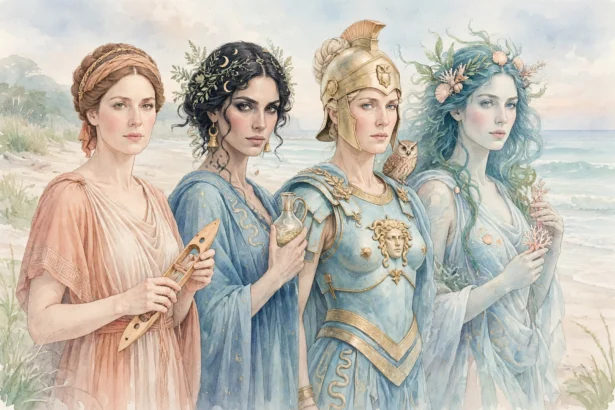
Who knew that every voyage begins and ends in the human heart
There is a curious habit we have with epics.
We remember the man who travelled.
We forget the women who understood the journey.
For centuries, The Odyssey has been read as the story of Odysseus, the ingenious king who outwitted monsters, escaped gods, and spent ten years trying to find his way home after the fall of Troy. Yet each time I return to Homer, I find myself reading a different book.
Not a story about movement.
A story about stillness.
Not about conquest.
About consciousness.
The sea is merely the landscape. The real voyage takes place in the encounters with women who are less characters than states of being. They are mirrors, thresholds, prophecies. Each one reveals not who Odysseus is, but who he could become if he surrendered to desire, memory, power, despair or wisdom. Perhaps that is why the poem begins not with Odysseus himself, but with an invocation:
“Tell me, Muse, of the man of many ways…”
The Muse is a woman. Before the hero speaks, a woman’s voice grants him language.
It is a detail we rarely pause to notice.
Penelope & The Architecture of Hope
History has been unfair to Penelope.
It celebrates Odysseus for wandering the world and remembers Penelope merely for waiting.
But waiting is too passive a word for what she accomplishes.
She governs a kingdom under siege.
She raises a son into adulthood.
She negotiates with dangerous men.
She invents perhaps literature’s greatest political performance,“By day she wove the mighty web; by night… she unwove it.”
The loom becomes strategy.
Thread becomes time.
Patience becomes rebellion.
Penelope understands something our impatient century has forgotten: endurance is not the absence of action. It is action stretched across time.
She does not wait because she is weak. She waits because she refuses to surrender the story to people who have mistaken force for destiny.
Athena & The Intelligence That Does Not Need Applause
Athena never asks to be the hero.
She makes heroes possible.
Again and again she appears disguised as mentor, traveller, shepherd, little girl, because wisdom rarely arrives announcing itself.
She embodies a truth that organisations, governments and families often overlook: the finest leadership is almost invisible.
It creates conditions.
It nudges.
It reframes.
Athena reminds us that power need not dominate to transform.
Perhaps that is why Homer makes her Odysseus’ greatest ally.
Not because they are alike.
Because they both understand that intelligence is most effective when it serves something larger than ego.
Circe & Calypso, Two Different Kinds of Captivity
Popular retellings often reduce Circe and Calypso to seductresses.
Homer is subtler.
Both offer Odysseus something every human secretly longs for.
Rest.
Escape.
An end to uncertainty.
Calypso even offers immortality.
Yet he refuses.
Why? Because a perfect life without freedom is another form of prison.
Circe transforms men into swine, but perhaps Homer is asking whether she changes them at all or merely reveals the instincts they have carried with them.
Both women ask the same question in different ways:
What part of yourself are you willing to surrender in exchange for comfort?
It is not an ancient question.
It is today’s question.
How much freedom do we exchange for convenience?
How much curiosity for certainty?
How much authenticity for approval?
Nausicaa & The Grace Before The World Hardens Us
Among storms and monsters arrives a young woman doing something astonishingly simple. She notices.
She sees a naked, exhausted stranger emerging from the sea.
She does not look away.
She does not panic.
She chooses generosity.
In a culture increasingly organised around suspicion, Nausicaa reminds us that civilisation begins with hospitality.
Not grand gestures.
Small recognitions of another person’s humanity.
The Sirens Still Sing
The Sirens have survived every century because they change their voices.
Once they sang from rocky islands. Today they arrive through glowing screens.
They promise certainty. Recognition. Outrage. Importance. Distraction.
Odysseus survives not because he is stronger than temptation but because he knows he cannot trust himself. He asks to be tied to the mast. What extraordinary humility. Real strength, Homer suggests, is designing a life that protects you from your own weaknesses.
What the Women Know
The women of The Odyssey are not resting places along a man’s journey. They are the journey. Penelope teaches fidelity not simply to a person, but to one’s deepest convictions.
Athena teaches that wisdom is quieter than power. Circe asks whether transformation is punishment or possibility. Calypso exposes the loneliness hidden inside possession.
Nausicaa restores faith in uncomplicated goodness.
Even the Sirens remind us that every meaningful life requires the discipline to ignore beautiful distractions. Odysseus crosses oceans. The women cross states of being. And perhaps that is the greater voyage. Homer ends where he began, with home. But home, by then, is no longer geography.
It is recognition.
The Greek word nostos, from which we derive nostalgia, means “homecoming.” Yet The Odyssey suggests that home is not merely the place we return to. It is the self we recover after every illusion has fallen away. The women of the epic understand this long before Odysseus does. Perhaps that is why, nearly three thousand years later, they remain startlingly alive.
The hero reaches Ithaca.
The women reach us.
