
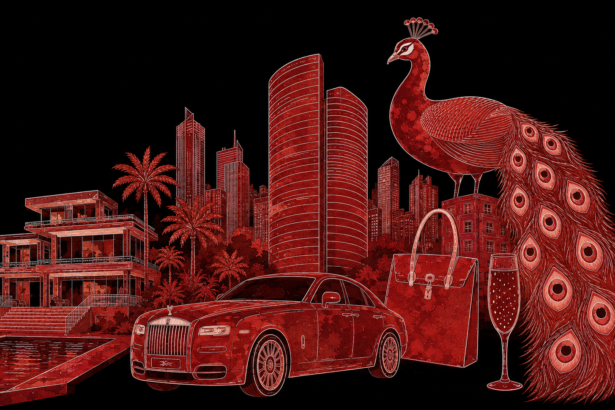
There used to be a clean border between the things you wore and the walls you lived inside. A watch was a watch, a house was a house, and the two only met, if ever, in the private fantasy of a very rich man imagining his own life as a magazine spread. That border has been dissolving in India for a few years now, quietly, the way most real revolutions happen, not with an announcement, but with a groundbreaking ceremony that nobody outside the industry thought to notice.
Consider the news, unremarkable on its surface: Jacob & Co. the watchmaker whose timepieces have made cameos in more rap videos than architecture journals, is putting its name on a tower in Noida. Elie Saab, a couturier whose gowns exist mostly to be photographed on red carpets, now has residences bearing its name rising in both Gurugram and Noida. These are not simply ordinary buildings carrying a famous name. They are increasingly being conceived as branded residences from the outset, with the brand’s design language and identity becoming part of the proposition. A decade ago this would have sounded like satire. Today it is simply the market.
What makes this moment different from India’s older tryst with prestige real estate is the direction the influence is flowing. It used to be that a builder erected something tall and expensive and then borrowed a foreign word like Imperial, Palais, Trump, to lend it gravity, the way a restaurant borrows a French name to seem serious. Now the sequence has reversed. The fashion house, the jeweller, the watchmaker arrives with an entire design language already fully formed; a signature colour, a silhouette, a philosophy of luxury tested for years on runways and boutique counters and simply pours it into concrete.
Armani/Casa was among the early high-profile examples in India, including its association with Lodha’s World Towers in Mumbai; Four Seasons has been developing branded residences globally for years. But Jacob & Co. and Elie Saab represent something sharper: names with no prior connection to shelter at all, entering real estate through partnerships because the Indian buyer has made clear that a brand’s meaning can now be experienced in square footage as easily as on a wrist or a runway.
The merging of categories is genuinely fascinating, and only a little troubling. Fascinating, because it suggests luxury consumption in India has matured past the trophy-object stage into something more architectural in ambition as buyers no longer want merely to hold prestige in their hands, they want to live inside its logic, wake up every morning within its aesthetic grammar. A Jacob & Co. residence promises, presumably, the same obsessive maximalism the brand applies to a $500,000 watch, scaled up to a foyer, a private elevator lobby, and a penthouse. An Elie Saab address borrows the drama of couture: the draping, the ornament, the theatrical sense of arrival and applies it to a building’s facade and lobby the way a gown is applied to a body walking a red carpet. The apartment becomes, in effect, wearable architecture.
The troubling part is the same as it always is with borrowed prestige: does the brand actually know how to build a home, or does it simply know how to sell a fantasy that happens, this time, to come with a floor plan? A watch that malfunctions is an inconvenience. A tower with poor plumbing and a famous name on the entrance is a much more expensive kind of disappointment. Branded residences in India are still young enough that nobody has fully tested what happens ten years in, when the marble needs resealing and the brand’s design team has long since moved on to the next licensing deal in Dubai or Miami. Prestige, unlike concrete, does not actually bear load.
Still, the trend has its own undeniable momentum, and it is reshaping how developers think about differentiation in a market that has, frankly, run out of new adjectives for “luxury.” When every project claims sea views, smart automation, and a wellness spa, the only remaining lever is a name the buyer already trusts from somewhere else, a name they have perhaps already spent money on, in a smaller form, at a boutique in DLF Emporio or Jio World Plaza. The residence becomes the largest, most permanent purchase associated with a brand, and the buyer becomes, in a real sense, a lifelong customer rather than simply a homeowner.
The numbers now back up what was, until recently, mostly a hunch. Reports citing Noesis Capital Advisors estimate that India’s branded-residences market could grow by around 60 percent by 2027, with committed supply rising from roughly 4,000 units to around 6,000–6,500 units. The acceleration is remarkably recent: an estimated 40–45 percent of the country’s branded-residence inventory, roughly 1,500–1,800 units, has been launched or committed since 2021. Delhi-NCR currently leads with around 2,117 units in the pipeline, ahead of Mumbai’s 715, Pune’s 479, Odisha’s 402 and Chennai’s 123.
Where This Goes
If the pattern holds, the next five years should see the border between fashion houses and construction sites dissolve almost entirely. Watchmakers, couturiers, and hospitality names that have never touched real estate will keep entering through licensing and development partnerships rather than building anything themselves, the brand supplies the aesthetic and the story, a local developer supplies the land, the labour, and the actual engineering risk.
Savills India has projected nearly 200 percent growth in India’s branded-residences market through 2031, well beyond the more conservative 60-percent-by-2027 projection. The expansion is being fuelled by India’s growing wealth base as well as increasing interest from global luxury brands and developers.
What to expect? Certainly more luxury brands are lending their name to concrete as luxury moves beyond the fashion ramps. Geography could extend too into Hyderabad, Bengaluru and Pune, even as NCR and Mumbai continue to dominate the existing market. Underpinning all of it is a wealth base still compounding fast.
Knight Frank projects India’s ultra-high-net-worth population to grow by just over 50 percent by 2028, the fastest projected growth rate anywhere in the world, which is ultimately the number the brands are betting on.
The address is the label you were so far flashing from a bag tag.
