
Waswo X. Waswo on artificial intelligence, artistic imagination and the human hands behind his miniature worlds.
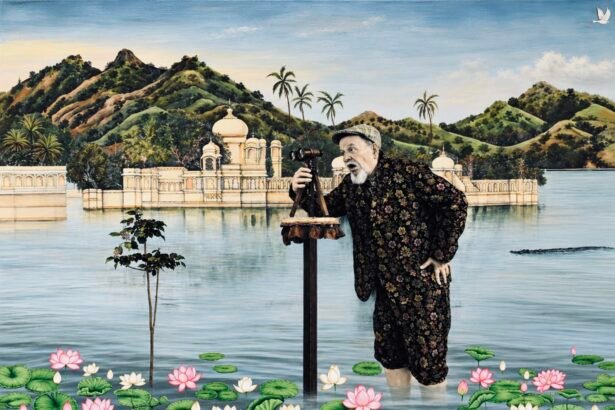
A Dandy arrives in an Ancient Land. He encounters a Prince, forms an intimate friendship, and becomes entangled in a world of desire, rivalry, memory and exile. The story unfolds across a gallery, its characters suspended between history and invention, belonging and estrangement. At its centre is a familiar figure: the outsider who has travelled far enough to become part of the landscape, but not so far that he can entirely disappear into it.
The Dandy is, in many ways, Waswo X. Waswo himself.
At Long Short Stories, his exhibition at Latitude 28 in New Delhi, the American-born, Udaipur-based artist builds a fictional universe through Rajasthani miniature painting, photography, video and sculpture. The exhibition, on view from October 10 to November 20, 2026, invites visitors to read the gallery as a book, moving between images that collectively tell a story of intimacy, displacement and memory.
But there is another story unfolding here: the story of an artist whose imagination depends on collaboration, whose visual language draws on a living Indian tradition, and whose latest experiments bring artificial intelligence into the creative process.
In an era when AI has unsettled the creative industries, Waswo’s position is strikingly clear.
“AI can’t take away anything from human imagination. It has helped expand what a human mind can imagine. So we experimented with AI in this series to build on and develop our core ideas, and then improvised on what we got. Art will always include technology. It includes everything, but technology cannot dictate art,” Waswo tells Mocha Ink Mag.
It is a statement that places the human imagination firmly at the centre of the debate. For Waswo, AI is neither an existential threat to art nor an autonomous creative force. It is a tool through which an idea can be extended, tested and reimagined. The decisive act remains human: the judgement to select, reject, alter and make something meaningful out of what the technology produces.
Yet the assertion that technology cannot dictate art invites a more demanding question. Who exercises that human judgement? And how does the arrival of AI change the relationship between the artist who conceives an image and the skilled practitioners who give it physical form?
These questions matter particularly in Waswo’s practice, where the finished work is inseparable from the expertise of Udaipur’s miniature painters.
The outsider who made India home
Waswo’s relationship with India began in 1993, when he first visited for a brief stay. He returned in 1999 and spent increasingly extended periods in Rajasthan before buying a home in Udaipur in 2006. What began as an engagement with the country’s visual and cultural landscape developed into a sustained artistic collaboration with local craftsmen.
His work has since moved between photography, hand-coloured digital prints and miniature painting, often combining these media in compositions that blur the boundaries between documentary observation and staged fiction.
Waswo has also made his position as a Western artist working in India part of his artistic vocabulary. His recurring self-portraits and invented personas turn the gaze back on the observer, exposing the peculiarities and contradictions of the outsider’s relationship with the place he inhabits.
The Dandy continues this interrogation. He is not merely a spectator of an unfamiliar culture; he becomes a participant in its imagined world. His presence complicates the distinction between the person telling the story and the person being represented.
But self-awareness is not the same as resolution. An artist can acknowledge the privileges of his position without necessarily dismantling them. The question is whether that awareness extends beyond the artist himself to the people and traditions that make his work possible.
The human hands behind the image
Waswo’s studio operates as an extended karkhana, a collaborative workshop in which his conceptual direction meets the accumulated knowledge of traditionally trained miniature painters.
His collaborators include Dalpat Jingar, Banti Jingar, Shankar Kumawat and Chirag Kumawat. Their skills are integral to the finished work.
Dalpat Jingar, who joined the studio in 2012, brings expertise in figure painting and the hand-colouring and embellishment of photographic images. Shankar Kumawat has spent more than four decades practising miniature painting, with particular skill in intricate borders informed by Persian, Chinese and Mewari traditions. His son, Chirag Kumawat, the studio’s chief miniaturist, brings his own training and figurative expertise to the compositions. Banti Jingar specialises in landscapes, palaces, forts, pigments and gold leaf.
The distinction between the initial idea and the final artwork is therefore not a simple one. The work develops through the interaction of conceptual direction and specialised knowledge. The painters contribute more than technical execution: their training and judgement determine how an image acquires its visual character.
This makes the introduction of AI particularly interesting.
If a generative tool helps develop the core idea, the miniature painter’s task is not necessarily to reproduce the machine’s output. It may instead involve interpreting, correcting or transforming a visual suggestion through a tradition of painstaking manual practice.
The machine can produce possibilities. The artist and the artisans must decide what those possibilities are worth.
That distinction is crucial. AI can generate an image in seconds, but the knowledge required to create a convincing miniature is acquired over years. The two processes are not equivalent, even when they contribute to the same finished work.
The more useful question is not whether AI can make art. It is how the technology changes the process of making art, and whether the human expertise involved becomes more visible or more easily overlooked as a result.
Can AI expand imagination without diminishing craft?
Waswo’s argument is that AI expands the possibilities of the human mind. His description of experimenting with the technology, developing core ideas and improvising on the results suggests a process in which the machine supplies material for further creative decisions rather than determining the final outcome.
This is a compelling distinction between using AI as a creative instrument and allowing it to dictate an aesthetic.
But the distinction must be examined in practice. What happens to the original idea when the machine proposes alternatives? Which elements are retained, and which are rejected? How do the miniature painters respond to AI-assisted imagery? Does the technology enable them to explore new visual possibilities, or does it place additional pressure on them to translate machine-generated complexity into painstaking manual work?
The answers would reveal far more about the artistic significance of AI than the mere fact of its use.
There is also a larger question of value. In a creative economy increasingly fascinated by speed and scale, the labour-intensive nature of miniature painting represents a very different understanding of artistic production. Its value lies not simply in the image produced, but in the knowledge, discipline and time embodied in it.
The danger is that AI becomes the headline while the human craft becomes the footnote.
For an artist whose practice depends on collaboration, this is an especially important tension to acknowledge. If AI is to expand imagination without diminishing craft, the people whose expertise transforms an idea into an artwork must remain visible in the conversation about how that artwork is made.
Waswo’s assertion that technology cannot dictate art is therefore best understood as a principle to be tested, rather than a debate conclusively settled.
Who gets to tell the story?
The exhibition’s narrative, developed with Long Short Stories, gives the images a literary structure. The Dandy travels through an Ancient Land, encounters a Prince and becomes entangled in a world of friendship, desire, rivalry and exile.
The framework encourages viewers to move between text and image, treating the exhibition as a sequence of interconnected chapters rather than a collection of isolated works.
Do go. Witness inclusion.