
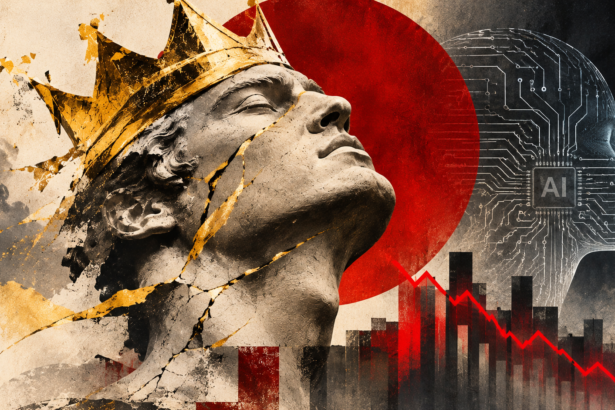
When success gets too big for its own good
Power builds empires. Success creates believers. And somewhere between the two, the ability to recognise one’s own limitations can quietly disappear. Why do some of the world’s sharpest minds make decisions that put everything they have built at risk?
There is something fascinating about watching extraordinarily successful people make extraordinarily reckless decisions. People who can anticipate market disruptions, negotiate billion-dollar deals and command thousands of employees sometimes appear incapable of anticipating the consequences of a personal indiscretion. An affair. An undisclosed relationship. A compromised professional boundary. An assumption that nobody will find out.
And suddenly, the corner office becomes a crisis-management centre.
The resignation of Jensen Huang, Nvidia’s co-founder and CEO, on November 12, 2026, offers an extraordinary illustration of this paradox. A man who helped power the global artificial intelligence revolution has exited the company he built following revelations about extramarital relationships. What began as a personal controversy rapidly expanded into questions of corporate governance, disclosure, national security and the geopolitics of advanced semiconductor technology.
One relationship involved Alice Huang, a Chinese businesswoman associated with Megaspeed International, an Nvidia business partner. US authorities reportedly suspect her of links to Chinese intelligence, although these allegations remain unverified by Reuters and have been denied by Beijing. Further reporting identified another relationship involving an Nvidia employee. Nvidia’s independent directors initiated an investigation, and the board appointed CFO Colette Kress as interim CEO.
The consequences extended well beyond the executive suite. Nvidia’s shares fell 4.3% on the day of the resignation, while the company faced renewed scrutiny over its China business and the leadership of an ecosystem central to the global AI boom. The broader market decline had multiple causes, but the controversy added a significant new layer of uncertainty.
The technology did not stop working. Nvidia’s engineers did not forget how to build chips. But confidence in the leadership and commercial relationships surrounding the company was shaken. It was a reminder that even the most technologically sophisticated enterprises remain vulnerable to human judgement.
Why do intelligent people make such decisions? Management psychology has a term for one possible explanation: CEO hubris.
Hubris is more than arrogance. It is an inflated sense of self-importance, an exaggerated belief in one’s abilities and, eventually, the conviction that ordinary limitations do not apply. Success, after all, has a psychology of its own.
The characteristics that propel people to the top: ambition, competitiveness, persistence, risk appetite and confidence can become liabilities when left unchecked. Every successful acquisition, profitable quarter or strategic victory reinforces the executive’s belief in personal instinct. Gradually, confidence becomes overconfidence. The internal narrative shifts from “I can make this work” to “I know better than everyone else”. In its most dangerous form, it becomes “I can get away with this”.
Researchers Valérie Petit and Helen Bollaert explored this phenomenon in their 2012 paper, Flying Too Close to the Sun? Hubris Among CEOs and How to Prevent It. Their work examined how excessive pride can distort a leader’s relationship with themselves, other people and the world around them. The distinction is important: confidence can build an empire; the conviction that one cannot be wrong can endanger it.
Power also brings attention, access and constant validation. The room listens when you speak. Your decisions influence careers. People seek your approval. For someone whose identity is deeply intertwined with achievement, this can become intoxicating. Sometimes, the attraction is not simply to another person or opportunity, but to the feeling of being exceptional, desired and untouchable.
Corporate history offers several reminders of how personal indiscretion can become public consequence. In September 2025, Nestlé dismissed CEO Laurent Freixe following an investigation into an undisclosed romantic relationship with a direct subordinate that breached its code of business conduct. BP’s Bernard Looney resigned in 2023 after acknowledging that he had not been fully transparent about personal relationships with colleagues. In 2019, McDonald’s dismissed Steve Easterbrook over an inappropriate relationship with an employee; subsequent investigations and SEC proceedings revealed further disclosure failures.
Different circumstances, but a recurring lesson: a CEO’s private decisions are not always private in their consequences. Relationships involving employees can raise questions of authority, conflicts of interest, preferential treatment and institutional trust. What one individual sees as a personal matter, the board may have to examine as a governance risk.
There is another danger of power: isolation. The higher people climb, the fewer are willing to challenge them. Subordinates hesitate, advisers choose their words and colleagues avoid confrontation. Eventually, the executive inhabits an echo chamber where disagreement feels like disloyalty and affirmation becomes the norm.
Good judgement requires friction. It requires someone willing to question assumptions, challenge impulses and deliver uncomfortable truths. Without that corrective mechanism, success can become a dangerous feedback loop.
The mythology of Icarus remains an apt metaphor. He did not fall because he lacked ambition or the ability to fly. He fell because he ignored the limits of his wings. In business, the equivalent may be a reckless acquisition, an undisclosed relationship or the conviction that influence can manage every consequence.
This is why independent boards, transparent disclosures and meaningful accountability matter. Organisations must be capable of challenging their most successful executives, not merely celebrating them. The cult of the indispensable founder can itself become a corporate risk when an organisation’s identity and strategic direction become too closely tied to one individual.
We spend enormous amounts of time celebrating intelligence. We recruit for it, reward it and promote it. But how much attention do we pay to restraint? To the ability to recognise when not to send that message, pursue that attraction, conceal that conflict or cross that professional boundary?
Privacy is not secrecy. Personal freedom is not a licence to disregard professional obligations. Discretion is not weakness. It is an essential leadership competency.
Perhaps the greatest irony of success is that it can gradually erode the humility, discipline and willingness to listen that made success possible in the first place.
The most dangerous person in the boardroom is not necessarily the least intelligent. It may be the one who has stopped questioning their own judgement.
Success tests ambition. Power tests character. Hubris tests whether one still knows the difference.
You can be brilliant enough to build an empire and reckless enough to risk it all. The ability to create something extraordinary is impressive. The ability to protect it from your own worst impulses is perhaps even more so.
Because sometimes, the greatest threat to an empire is not the competition, the market or the next technological disruption.
It is the person sitting at the very top.